






Affiliate disclosure: This page contains Amazon affiliate links. If you buy through them, we may earn a commission at no extra cost to you. It never changes which products we recommend or what we say about them.
The best binoculars for hunting on a budget are the Vortex Triumph HD 10×42 for most hunters and the Celestron Outland X 8×42 for timber and dim light. By the end of this guide, you’ll know which magnification fits your terrain and which cheap listings fall apart the moment the sun dips.
BowsHunting.com doesn’t field-test optics. Every pick below was chosen by cross-checking manufacturer and retailer spec sheets, then running each one through the math that decides what a hunter actually sees at dawn.
Our picks at a glance
- Best overall value: Vortex Triumph HD 10×42
- Best for timber and low light: Celestron Outland X 8×42
- Cheapest bright view: Bushnell Falcon 10×50
- Pocket backup: Bushnell PowerView 10×25
- Tripod-only reach: Adorrgon 15×45
- Spotting scope upgrade: Celestron Ultima 20-60×80
How the picks compare on paper
These are the specs that separate the best binoculars for hunting from ones that only look good on a listing. Exit pupil and eye relief matter most. A hunter’s eye opens to roughly 5–7 mm in low light, according to Sightmark’s binocular buying guide, so an exit pupil near 5 mm keeps the image bright at legal shooting light.
| Model | Exit pupil | Field of view (ft @ 1,000 yd) | Eye relief | Weight | Prism glass | Weather sealing |
|---|---|---|---|---|---|---|
| Vortex Triumph HD 10×42 | 4.2 mm | 334 | 17 mm | 22.9 oz | Phase-coated BaK-4, roof | Waterproof, nitrogen-purged |
| Celestron Outland X 8×42 | 5.25 mm | 357 | 18 mm | 22 oz | BaK-4, roof | Waterproof, nitrogen-purged |
| Bushnell Falcon 10×50 | 5 mm | 300 | 9 mm | 27 oz | BK-7, Porro | Not listed as waterproof |
| Bushnell PowerView 10×25 | 2.5 mm | n/a | 9 mm | 10.4 oz | Roof | Not listed as waterproof |
| Adorrgon 15×45 | 3 mm | 256 | n/a | 17.6 oz | BAK4 (per listing) | Listed as waterproof |
| Celestron Ultima 20-60×80 (scope) | 4–1.3 mm | 105–53 | 18 mm | 57 oz | BaK-4 | Waterproof, nitrogen-filled |
Exit pupil = objective lens size ÷ magnification. “n/a” means the sources we checked didn’t list the spec or disagreed.
The best budget binoculars for hunting, reviewed
Ranked by how much hunting each one can actually do.
Vortex Triumph HD 10×42: best overall value

Disclaimer: Prices are at time of the review and subject to change.
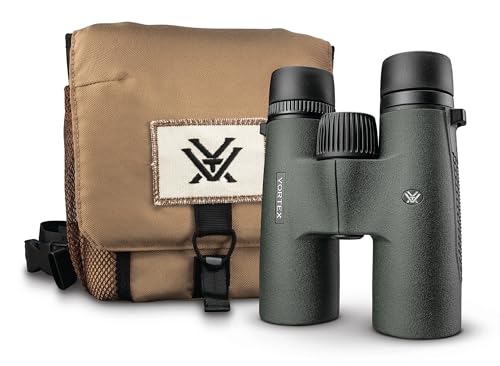
The Triumph HD is a full-size 10×42 roof prism binocular built for hunters who want real glass without the premium price. Outdoor Life’s 2026 hunting binocular test named it the best budget pick and put its street price under $100.
Vortex lists a 334-foot field of view, 17 mm of eye relief, a 15.3-foot close focus and a 22.9-ounce weight. The lenses are fully multi-coated, the prisms are phase-coated BaK-4, and the body is waterproof and nitrogen-purged against fogging. Vortex also ships it with a GlassPak chest harness, which most budget binoculars leave out.
The deciding factor is the warranty: the same unlimited, unconditional lifetime VIP coverage Vortex puts on its expensive optics. For a binocular that will eventually hit the ground under a treestand, that beats an extra point of sharpness.
The trade-off: the glass is where Vortex saved money. Outdoor Life’s testers scored its optics only fair, ranked it near the bottom of their field for low-light brightness, and noted blue color fringing, soft edges and a flimsy feel. That’s against binoculars costing many times more, but it means the Outland X 8×42 is the better pick if you mostly glass at first and last light. As a first binocular with a harness and a warranty that covers mistakes, it’s still the easiest of the best binoculars for hunting to recommend.
Celestron Outland X 8×42: best for timber and low light


Disclaimer: Prices are at time of the review and subject to change.
The Outland X 8×42 is the brightest handheld pick here. Its 5.25 mm exit pupil sits right in the range a dilated eye can use, and its 357-foot field of view is the widest on the list.
That suits whitetail hunters in hardwoods: a wider view finds a flicking ear faster, and 8x holds steadier after a climb. B&H’s spec sheet lists 18 mm of eye relief, a 13.1-foot close focus, BaK-4 roof prisms and a nitrogen-purged, waterproof body at 22 ounces.
The trade-off: the lenses are multi-coated rather than fully multi-coated, so contrast trails the Triumph in bright, flat light. Retailers also report its warranty inconsistently, so confirm the current terms on the listing before you buy.
Bushnell Falcon 10×50: the cheapest bright view

Disclaimer: Prices are at time of the review and subject to change.
If you want 10×50 binoculars for hunting on the smallest budget possible, the Falcon is the honest entry point. The 50 mm lenses give a 5 mm exit pupil, so the image stays bright at dawn even though the glass is basic.
It’s an old-school Porro design with BK-7 prisms and fully coated (not multi-coated) lenses. OpticsPlanet and B&H list a 300-foot field of view, 9 mm of eye relief, a 25-foot close focus and 27 ounces. The InstaFocus lever is easy to work with gloves on.
The trade-off: 9 mm of eye relief is too short for most eyeglass wearers, and none of the spec sheets we checked list it as waterproof. Treat it as a truck or blind binocular, not a rain-day glass.
Bushnell PowerView 10×25: a pocket backup, not a main glass


Disclaimer: Prices are at time of the review and subject to change.
The PowerView 10×25 earns a spot for one job: riding in a jacket pocket or pack lid as a backup. B&H lists it at 0.65 pounds with 9 mm of eye relief.
Its 2.5 mm exit pupil is half of what you want at first light, so the image dims right when deer start moving. B&H doesn’t list it as waterproof, and Bushnell sells other PowerView models as not water- or fog-proof.
The trade-off: good for midday scouting, a kid’s first pair, or a spare in the truck. Don’t make it your only binocular.
Adorrgon 15×45: tripod-only reach

Disclaimer: Prices are at time of the review and subject to change.
The Adorrgon 15×45 is a high-magnification binocular that only makes sense on a tripod. The Amazon listing claims BAK4 prisms, fully multi-coated optics, a waterproof body, a 256-foot field of view and a 1.1-pound weight, and it ships with a tripod and a phone adapter.
Handheld at 15x, every heartbeat shows in the image. Mounted, the reach helps you judge a buck across a bean field. Its 3 mm exit pupil makes it a good-light tool, not a dawn tool.
The trade-off: it’s a lesser-known brand, and its specs come from the seller’s listing rather than an independent spec sheet. Buy it as a second binocular for glassing from a rest.
Celestron Ultima 20-60×80: the spotting scope upgrade


Disclaimer: Prices are at time of the review and subject to change.
The Ultima isn’t a binocular. It’s an 80 mm angled spotting scope, here because it solves the problem most hunters try to fix with 15x or 20x binoculars.
Celestron lists a 20–60x zoom, a 105-foot field of view at 20x, 18 mm of eye relief, a 26.2-foot close focus and a 57-ounce weight. It’s waterproof, nitrogen-filled, and covered by a limited lifetime warranty. The 45-degree eyepiece is easier to use from a seated glassing position.
The trade-off: it needs a tripod every time, and at 57 ounces it’s a truck, blind or base-camp tool for most hunters. Pair it with an 8×42 or 10×42 rather than replacing one.
How do you choose the best binoculars for hunting?
Pick the magnification your terrain needs, then make sure the exit pupil is big enough for the light you hunt in. Everything else, from coatings to weight, is a tiebreaker. A binocular is a pair of matched telescopes that magnifies distant game for both eyes at once, and the two numbers on it (like 8×42) tell you most of what it can do.
8×42 vs 10×42 for hunting
The 8×42 vs 10×42 for hunting choice comes down to how far you glass. The first number is magnification; the second is the objective lens diameter in millimeters.
- 8×42: wider view, steadier image, brighter at dawn (5.25 mm exit pupil). Best for timber, brush, treestands and anything inside about 300 yards.
- 10×42: more detail on distant or bedded game, at the cost of more visible shake and a 4.2 mm exit pupil. Best for open country, ridges and field edges.
If you can only own one and you hunt mixed country, 10×42 is the more common default. If most of your hunting happens in the woods, 8×42 is the more forgiving choice.
Exit pupil decides what you see at dawn
Exit pupil is the width of the beam of light a binocular sends to your eye. If you want the best low light hunting binoculars, start here, because no coating can replace light that never reaches you.
A 5 mm exit pupil fills a dilated eye; a 2.5 mm one leaves half of it dark. That’s why the Outland X 8×42 and the Falcon 10×50 both outshine compact 10×25 glass at dawn, even though neither is premium.
Prism glass and lens coatings
BaK-4 prisms transmit light more cleanly than BK-7 prisms, which is why most of the best binoculars for hunting above entry level use them. Coatings matter next: “fully multi-coated” means every glass surface has several anti-reflection layers, while “coated” or “multi-coated” covers less.
Roof prism binoculars are slim and straight-barreled. Porro prism binoculars like the Falcon have offset barrels and give a bright image for little money, but they’re bulkier and usually less weather-tight.
Eye relief, weight and weatherproofing
Eye relief is the distance your eye can sit from the eyepiece and still see the full image. Glasses wearers generally need about 17 mm or more, which rules out the 9 mm Falcon and PowerView for most of them.
Every full-size pick here weighs 22 to 27 ounces, which matters more the farther you walk. For weather, look for “waterproof” plus “nitrogen-purged” or “fogproof”; a binocular that fogs inside on a cold morning is useless until it warms up.
Which binocular fits your hunting style?
Match the binocular to where you hunt, not to the biggest number on the box. This table is the fastest way to narrow down the best binoculars for deer hunting, elk country and everything in between.
| How you hunt | Typical glassing distance | Best configuration | Pick from this list |
|---|---|---|---|
| Whitetail in hardwoods or a treestand | Under ~300 yards | 8×42 | Celestron Outland X 8×42 |
| Field edges, food plots, mixed country | 100–600 yards | 10×42 | Vortex Triumph HD 10×42 |
| Dawn and dusk sits from a blind | Any, in low light | 8×42 or 10×50 | Outland X 8×42 or Bushnell Falcon 10×50 |
| Western open country (mule deer, elk, pronghorn) | Long, often from a rest | 10×42 plus a spotting scope | Triumph HD 10×42 + Celestron Ultima |
| Bowhunting, still-hunting through cover | Shots inside 40 yards, glassing farther | 8×42 | Outland X 8×42 |
| Midday scouting, backup glass | Short to mid | Compact | Bushnell PowerView 10×25 |
From the field: [HUNTER NOTE pending. 2–4 sentences from a real hunter: name, state, what they hunt, what they glass with and why. Publisher to supply before publishing.]
What are the best binoculars for bowhunting?
The best binoculars for bowhunting are usually 8x, because bowhunters spend more time picking apart cover at close range than counting points across a canyon. Of our picks, the Celestron Outland X 8×42 fits that job best.
A bow shot happens inside 40 yards, but the glassing that sets it up doesn’t. You’re scanning brush for a leg, a tine or a flicking tail, often at the edges of the day, and a wide, bright, steady view does more for that than extra magnification. Outdoor Life’s earlier hunting binocular test reached a similar conclusion, naming an 8×32 as its bowhunting pick.
If you also hunt open ground with a rifle, the Triumph HD 10×42 is the better single binocular.
Why do 20x and 200x Amazon binoculars fail hunters?
High-magnification budget binoculars fail at dawn because their exit pupils are too small to deliver light to a dilated eye. Divide the lens size by the magnification and the problem shows up immediately.
- A “200×25” listing: 25 ÷ 200 = 0.125 mm exit pupil. That’s physically unusable, which tells you the 200x figure isn’t a real magnification.
- A 20×50 binocular: 50 ÷ 20 = 2.5 mm. That’s half of what a dilated eye can take in, so the image darkens right when game moves.
- A 10×42 binocular: 42 ÷ 10 = 4.2 mm. Bright enough for most hunting light.
Magnification also multiplies hand shake. At 20x, a resting pulse is enough to blur a buck you’re trying to judge. Most hunters find 10x the practical limit for handheld glassing, which is why the higher-power pick on this list ships with a tripod.
That’s why we cut several best-selling listings. A binocular that wins on a product page but goes dark at first light isn’t one of the best binoculars for hunting, whatever its star rating says.
What does each step up in price buy?
Spending more on budget glass buys you three things, in this order: eye relief, better prism glass and weather sealing. Here’s how that plays out across the picks.
- Entry level (Bushnell Falcon 10×50): a bright 5 mm exit pupil, but BK-7 Porro prisms, basic coatings, 9 mm of eye relief and no waterproof rating.
- One step up (Celestron Outland X 8×42): BaK-4 roof prisms, 18 mm of eye relief and a nitrogen-purged, waterproof body.
- Top of the budget (Vortex Triumph HD 10×42): phase-coated BaK-4 prisms, fully multi-coated lenses, a chest harness in the box and an unconditional lifetime warranty.
If you’re shopping hunting binoculars under 200 dollars, that ladder is the checklist: insist on BaK-4 prisms, a waterproof and fogproof body, and enough eye relief for your eyes. Past that point, a better warranty is worth more than a fancier coating name.
How we evaluated these binoculars
To find the best binoculars for hunting on Amazon, we started with ten listings and kept six. Each was checked against the manufacturer’s page or an independent retailer spec sheet, then run through exit-pupil, eye-relief and magnification math to see how it would perform in real hunting light.
That cross-checking is what BowsHunting.com’s reviews are built on, and it changed this list. The Celestron Outland X listing turned out to be the 8×42 model, not the 10×42. Four other listings failed exit-pupil math or weren’t built for hunting, including two compacts marketed for theaters and kids.
We didn’t field-test these binoculars, and we won’t claim we did. Where a spec came only from a seller’s listing, we say so.
Key takeaways
- Vortex Triumph HD 10×42 is our top pick among the best binoculars for hunting on a budget: a chest harness and an unconditional lifetime warranty, though its glass trails pricier binoculars in low light.
- Choose 8×42 for timber, treestands and bowhunting; choose 10×42 for open country and field edges.
- Check the exit pupil before anything else. Divide lens size by magnification; aim for roughly 4–5 mm or more if you hunt at first and last light.
- Skip 20x and “200x” handheld listings. The math makes them dim and shaky, whatever the star rating says.
- In open country, add a spotting scope instead of buying more binocular magnification.
If you hunt mixed countries and want one binocular that does it all, check today’s price on the Vortex Triumph HD 10×42.
Frequently asked questions
Short answers to what hunters ask most before buying.
What magnification binoculars for hunting work best?
For most people, 8x or 10x. If you’re asking what magnification binoculars for hunting you need, use 8x for timber, treestands and low light, and 10x for open country and field edges. Above 10x, hand shake makes the image hard to use without a tripod or a solid rest.
Which binoculars for hunting with glasses work best?
Look for about 17 mm of eye relief or more. Among these binoculars for hunting with glasses, the Celestron Outland X 8×42 (18 mm) and the Vortex Triumph HD 10×42 (17 mm) are the strongest choices. Twist the eyecups all the way down before you raise them to your glasses.
Spotting scope vs binoculars for hunting: do you need both?
Most hunters need binoculars first. The spotting scope vs binoculars for hunting question only becomes real in open country, where you’re judging animals at long range. There, a 10x binocular for finding game plus a spotting scope on a tripod for judging it beats any single high-power binocular.
Are 20x binoculars good for hunting?
Not for handheld use. A 20×50 has a 2.5 mm exit pupil, so it’s dim at dawn and dusk, and the magnification exaggerates every tremor in your hands. If you need that much power, a spotting scope on a tripod does the job better.
Do you need binoculars for deer hunting?
Yes, even from a treestand. Binoculars let you confirm what’s moving in the brush without raising your rifle or drawing your bow, and they keep you from pointing a loaded weapon at everything you want to look at.
How much do hunting binoculars cost?
Anywhere from about $100 to over $3,000. Outdoor Life’s testing covered that whole span, from the roughly $99 Vortex Triumph HD to Swarovski’s NL Pure at about $3,450. Most hunters get the best value between $100 and $300, as long as the binocular has BaK-4 prisms, waterproofing and a solid warranty.
Do I need waterproof binoculars for hunting?
Yes, for a main binocular. Rain, snow and cold mornings put moisture on and inside your optics, which is why both of our top picks among the best binoculars for hunting are sealed and nitrogen-purged. Look for “waterproof” plus “nitrogen-purged” or “fogproof” so the lenses don’t fog internally when temperatures change.

