






The Review
The Samsung Demo Phone currently tops our rank of the greatest Samsung phones available, beating even the pricier iPhone Ultra Max Mega. So unsurprisingly this is an absolutely fantastic phone. The design isn't massively changed from the previous generation, but most other elements have been upgraded. This is what we call a big boost.
-
Display
-
Performance
-
Features
-
Usability
-
Battery Life
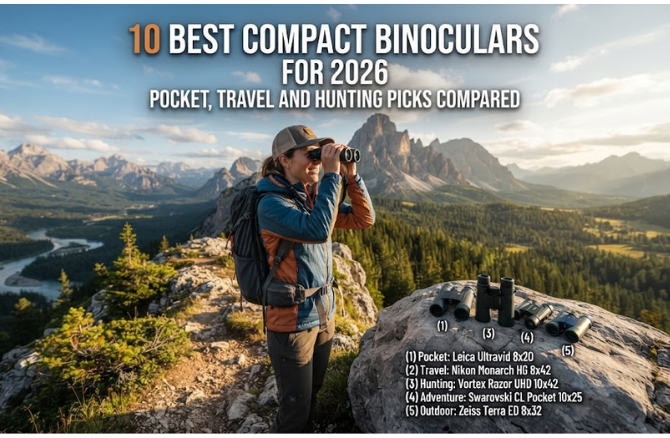
Eight small binoculars that slip into a pocket or pack, plus two full-size alternatives, compared on the specs that decide how bright and steady your view will be.
Affiliate disclosure: As an Amazon Associate, BowsHunting.com earns from qualifying purchases. This never changes which products we include or how we describe them.
The best compact binoculars pair 8x magnification with 21mm to 25mm lenses, which keeps the view steady and the weight well under a pound. Below are 10 picks with the exit pupil worked out for each one, so you can see which will stay bright at dawn and which only shine at noon.
Our Quick Picks
Each of the best compact binoculars below is a current Amazon listing, chosen for a specific job rather than ranked on one “overall” scale.
Compact binoculars (pocket and pack size)
- Best Overall: Nikon Trailblazer II 8×25
- Best Pocket Binoculars: VULNESS 8×21 Compact Binoculars
- Best for Glasses Wearers: Occer 12×25 Compact Binoculars
- Best for Concerts and Theater: POLDR 12×25 Small Pocket Binoculars
- Best Budget Backup Pair: DRANBOL 12×25 Mini Pocket Binoculars
- Budget Travel Pick: Hontry Compact Binoculars
- Best for Kids: vundueh Mini Compact Binoculars
- Longest Listed Warranty: “200×25” Compact Binoculars
Full-size alternatives (not compact)
- Best for Boating: Hooway 7×50 Marine Binoculars
- Best High-Power Full-Size: FLYANT 20×50 Binoculars
It achieves this by means of an accelerometer, a heart rate sensor, and GPS. There are already many smartwatches on the market such as the Pebble and Apple.
As you’re tapping, scrolling, and swiping on your phone, you probably don’t give much thought to the fact that your apps are consuming electricity just that they’re chipping away at your battery life.
Side-by-Side Specs
This table compares the best compact binoculars on this list at a glance. Every figure comes from the manufacturer’s own listing, manual, or product page. Where two listings disagree, we show the lower claim.
We calculated exit pupil ourselves by dividing lens size by magnification. A bigger number means a brighter view in dim light.
| Model | Size | Exit pupil | Listed weight | Listed field of view | Water rating |
|---|---|---|---|---|---|
| Nikon Trailblazer II | 8×25 | 3.1 mm | Not listed | Not listed | Submersible to 3.3 ft for 10 min |
| VULNESS | 8×21 | 2.6 mm | 5.6 oz | Not listed | Not listed |
| Occer | 12×25 | 2.1 mm | Not listed | 273 ft at 1,000 yd | Listed as waterproof |
| POLDR | 12×25 | 2.1 mm | Not listed | 126 ft at 1,000 yd | Not listed |
| DRANBOL | 12×25 | 2.1 mm | Not listed | Not listed | Not listed |
| “200×25” | Unverifiable | Unverifiable | 0.4 lb | Not listed | Listed as waterproof |
| Hooway (full-size) | 7×50 | 6.8 mm (listed) | 2.2 lb | 380 ft at 1,000 yd | Waterproof, floats |
| FLYANT (full-size) | 20×50 | 2.5 mm | Not listed | Conflicting claims | Splash use only |
How We Chose These Binoculars
We have not put these binoculars through a hands-on optical test, so we don’t publish numeric scores. To pick the best compact binoculars, BowsHunting.com judged every listing on five things we could check:
- Size class. REI’s buying guide defines compact binoculars as having objective lenses under 30mm, midsize as 30mm to 40mm, and full-size as over 40mm. Eight picks meet the compact definition; two are labelled full-size.
- Exit pupil. It is the single spec that best predicts brightness at dawn and dusk, and almost no listing states it.
- Weather protection. We report only the rating the maker actually lists.
- Claim honesty. Where a listing makes a claim that optics can’t deliver, we say so.
- Listing health. We checked that each ASIN resolves to a real product, and we flag any sign it may be discontinued.
The awards describe the job each pair fits, not a ranking from first to tenth.
Compact Binocular Reviews
Compact binoculars trade light-gathering power for portability. The best compact binoculars keep that trade small by staying at 8x, while the 12x models on this list give you more reach at the cost of a dimmer, shakier image.
Nikon Trailblazer II 8×25

Disclaimer: Prices are at time of the review and subject to change.
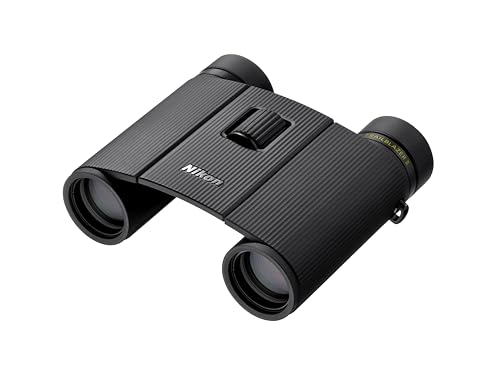
Nikon released the Trailblazer II in March 2026 as the update to its popular original Trailblazer, at a suggested retail price of $119.95. It is the only name-brand optic in the compact group, and it earns its place among the best compact binoculars with the most balanced spec on this list: 8x magnification with a 3.1mm exit pupil, the brightest of the compact picks.
Nikon’s product page describes a fold-up body built from aluminum alloy with textured rubber armor. The binocular can be submerged to 3.3 feet for up to 10 minutes, and Nikon markets the fogproofing as useful when you step from a warm truck into cold morning air. That’s exactly the moment a hunter needs clear glass.
Nikon doesn’t state the weight or field of view on the pages we could access. Check the Amazon listing before buying if either matters to you.
Pros
- Brightest exit pupil of the compact picks (3.1mm)
- Submersible to 3.3 feet for 10 minutes
- Aluminum body with rubber armor
- Name-brand optics and support
Cons
- Costs several times more than the other compact picks
- Weight and field of view not stated on the pages we checked
Key specs: 8×25 · 3.1mm exit pupil · waterproof and fogproof · fold-up design
Best for: Treestand and turkey hunters, hikers, and anyone who wants one compact pair that works in bad weather.
VULNESS 8×21 Compact Binoculars


Disclaimer: Prices are at time of the review and subject to change.
At 5.6 ounces, the VULNESS is the lightest pair on this list with a stated weight. It is true pocket binoculars territory: small enough for a jacket pocket or a purse. The listing pairs 8x magnification with 21mm lenses, a BAK4 roof prism, and fully multi-coated optics.
Focus runs through a center wheel with a separate right-eye diopter, and the kit includes a carry bag, lanyard, and cleaning cloth. Amazon shows this model first became available in May 2024.
The trade-off is those 21mm lenses. The 2.6mm exit pupil is fine in daylight but dims noticeably in shade and at dusk. One regional Amazon listing for this ASIN also labels it for adult use only and not suitable for children under 14, so we don’t recommend it as a kids’ pair.
Pros
- Lightest listed weight on this list (5.6 oz)
- 8x magnification keeps the view steady
- BAK4 roof prism and multi-coated lenses
Cons
- Small 21mm lenses struggle in low light
- Water resistance not stated
- One listing marks it adult use only
Key specs: 8×21 · 2.6mm exit pupil · 5.6 oz · BAK4 roof prism
Best for: Travel, concerts, and anyone who wants lightweight binoculars they’ll actually carry.
Occer 12×25 Compact Binoculars

Disclaimer: Prices are at time of the review and subject to change.
The Occer’s listing is built around eyeglass wearers. The rubber eyecups fold down so glasses can sit close to the lens, and the maker claims long eye relief with 15mm eyepieces. If you wear glasses, that combination matters more than any other spec on the box.
Occer lists a 273-foot field of view at 1,000 yards, a BAK4 prism, and broadband multi-coated lenses. The body is ABS plastic with rubber armor. It also has one of the longest track records here: Amazon price trackers have followed this listing since November 2017.
The 12x magnification is its weak point. It gives you more reach, but a 2.1mm exit pupil and extra hand shake make the image harder to hold steady. Occer calls it waterproof. One reseller’s product Q&A describes it as handling light rain and splashes, not submersion, so treat it as weather-resistant.
Pros
- Fold-down eyecups for glasses wearers
- Widest listed field of view among the 12x picks (273 ft)
- Long listing history
Cons
- 12x magnification is shaky handheld
- Dim in low light (2.1mm exit pupil)
- Plastic body
Key specs: 12×25 · 2.1mm exit pupil · 273 ft at 1,000 yd · BAK4 prism
Best for: Glasses wearers, beach and cruise viewing, and daylight sightseeing.
POLDR 12×25 Small Pocket Binoculars

Disclaimer: Prices are at time of the review and subject to change.
POLDR pitches this folding 12×25 at concerts, theater, and opera, and that is where it fits best. A stage is bright and it sits still, which hides the two weaknesses of a small 12x pair: a dim image and hand shake.
The listing describes a BAK4 prism, a center focus knob with a right-eye diopter, and a magnesium body. A neck strap, cleaning cloth, and carrying bag come in the box. It also states a field of view of just 126 feet at 1,000 yards, which is less than half the Occer’s listed figure, so treat that number cautiously.
A published owner review on Revain praised the low price and compact build. The same reviewer reported mediocre image quality, play in the focus control, and poor results in dim light. We couldn’t find water resistance stated anywhere.
Pros
- Folding body that fits a pocket
- Includes strap, cloth, and bag
- Suited to bright, stationary subjects
Cons
- Narrow listed field of view (126 ft)
- Owner reports of focus play
- No stated water resistance
Key specs: 12×25 · 2.1mm exit pupil · 126 ft at 1,000 yd (listed) · BAK4 prism
Best for: Concerts, theater, and sports from the stands.
DRANBOL 12×25 Mini Pocket Binoculars

Disclaimer: Prices are at time of the review and subject to change.
Among the best budget compact binoculars, the DRANBOL (model WYJ-01) is a no-frills 12×25 folding pair that first appeared on Amazon in April 2023. It ships with a strap, bag, cleaning cloth, and manual. That makes it a reasonable truck-console or glovebox spare, the pair you won’t mind losing.
Before you buy, check availability. The Amazon Canada listing for this ASIN marks it as discontinued by the manufacturer. The listing states a parcel weight of 172 grams including packaging, so the binocular itself weighs less than 6 ounces.
It shares the same limits as every 12×25 here: a 2.1mm exit pupil and noticeable shake without a brace.
Pros
- Very light, under 6 oz
- Complete kit with strap and case
- Low-risk spare pair
Cons
- Listed as discontinued on Amazon Canada
- Few published specs
- 12x is shaky handheld
Key specs: 12×25 · 2.1mm exit pupil · parcel weight 172 g
Best for: A spare pair for the truck, boat, or kitchen window.
Hontry Compact Binoculars
Disclaimer: Prices are at time of the review and subject to change.
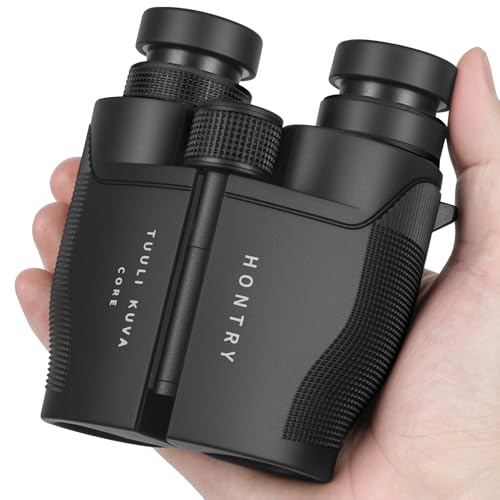
Hontry has sold budget compact binoculars online for years. Its best-documented model is the 10×25 model 8111, which Hontry’s own site describes as a Porro-prism design rated splash-proof, not fully waterproof. The company notes the design has existed for 20 years.
We couldn’t confirm the exact specs of this particular listing, so we won’t guess at them here. Check the magnification, weight, and water rating on the Amazon page before you buy.
Pros
- Established budget brand
Cons
- Specs not independently confirmed for this listing
Best for: Travelers on a tight budget who want compact binoculars for travel and sightseeing.
vundueh Mini Compact Binoculars
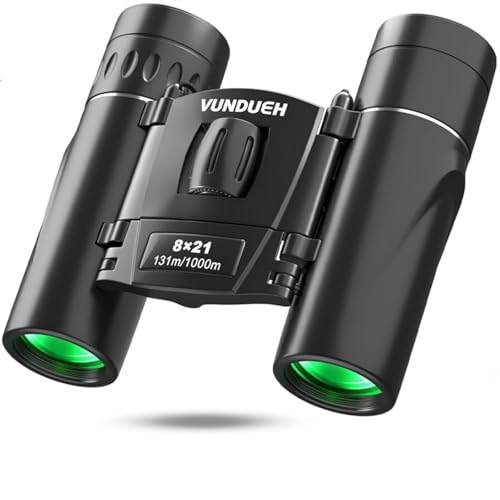
Disclaimer: Prices are at time of the review and subject to change.
The vundueh listing targets both adults and kids. It describes a non-slip body that it says is durable, shockproof, and waterproof. For a child, a shockproof, grippy body matters more than premium glass, because the pair will get dropped.
The listing we could access didn’t state the magnification. That matters for kids. The Cornell Lab of Ornithology recommends 7x or 8x for beginners, especially young people, because the wider view makes it easier to find a bird. If this pair turns out to be 10x or more, a younger child may struggle to hold the view steady.
Pros
- Aimed at kids and adults
- Listed as shockproof and waterproof
- Non-slip grip
Cons
- Magnification not stated in the listing we checked
Best for: A first pair of binoculars for a child who spends time outdoors.
“200×25” Compact Binoculars

Disclaimer: Prices are at time of the review and subject to change.
Ignore the number on the box. No handheld binocular with 25mm lenses can magnify 200x. At that power, the exit pupil would be about a tenth of a millimeter, far too small to show a usable image. Judge this pair on its other claims instead.
Those claims are practical ones. The seller lists a 0.4-pound weight, a size aimed at kids aged 8 to 12 and adults, a soft rubber focus wheel, and a five-year warranty with 24-hour customer service. That warranty is the longest listed among the budget picks.
Inflated magnification is common in this category. A BasinLens market analysis of portable binoculars on Amazon, which included this listing, found that sellers heavily emphasize extreme magnification figures such as 200x and 300x. Space.com’s buying guide makes the same point: listings from lesser-known brands are not always accurate, so treat bold claims with suspicion.
Pros
- Light at 0.4 lb
- Five-year warranty listed
- Sized for kids and adults
Cons
- The 200x claim is not physically possible, so the real magnification is unknown
- Few verifiable optical specs
Key specs: 25mm lenses · real magnification unverifiable · 0.4 lb · 5-year warranty (listed)
Best for: A light, low-risk gift where warranty matters more than optics.
Full-Size Alternatives (Not Compact)
These two aren’t among the best compact binoculars, because they don’t meet the compact definition. They sit here for readers who realize, after reading this far, that brightness or power matters more to them than pocket size. Neither belongs in a pocket or a treestand pouch.
Hooway 7×50 Marine Binoculars

Disclaimer: Prices are at time of the review and subject to change.
The Hooway is built for the water. It lists a 7x magnification, 50mm lenses, a 6.8mm exit pupil, and 22mm of eye relief. That’s the opposite end of the brightness scale from every compact pair above, and generous eye relief for glasses wearers.
Hooway adds marine features: an illuminated built-in compass, an internal rangefinder reticle for estimating distance, a nitrogen-purged fogproof body, and a design that floats. It is tripod adaptable, uses BAK4 Porro prisms with fully multi-coated optics, and comes with a floating foam strap.
The cost is size. At 2.2 pounds and about 200 × 85 × 150mm, it weighs several times more than any compact pick.
Pros
- Very bright 6.8mm exit pupil
- Floats, with compass and rangefinder reticle
- 22mm eye relief for glasses wearers
Cons
- 2.2 lb and bulky
- Two listings disagree on field of view (380 vs 396 ft)
Key specs: 7×50 · 6.8mm exit pupil · 380 ft at 1,000 yd · 2.2 lb · floats
Best for: Boating, fishing, and low-light viewing from a fixed spot.
FLYANT 20×50 Binoculars

Disclaimer: Prices are at time of the review and subject to change.
The FLYANT is for readers who want maximum reach at a low price. It lists 20x magnification, 50mm lenses, BAK4 Porro prisms, and a green multi-coating. The maker calls it waterproof for daily use but tells owners not to immerse it.
Twenty power is a lot to hold by hand. Every tremor is magnified 20 times, so plan to brace it on a rail, a fence post, or a car window. The 2.5mm exit pupil is also small for a 50mm pair, because the high magnification uses up the extra light.
Its listings contradict each other on field of view. One version states 168 feet at 1,000 yards; another claims a range from 520 to 3,000 feet. We can’t confirm either.
Pros
- Most magnification on this list
- BAK4 Porro prisms and multi-coated lenses
- Rubber grip
Cons
- 20x is very hard to hold steady by hand
- Conflicting field-of-view claims
- Not for immersion
Key specs: 20×50 · 2.5mm exit pupil · splash use only
Best for: Braced, daylight viewing of distant subjects, such as a field edge or a stadium.
How to Choose the Best Compact Binoculars
The right pair comes down to where you’ll use it and how much light you’ll have. Start with these five checks.
What Counts as Compact?
Small binoculars are defined by lens size, not by how they feel in your hand. REI’s guide sets the line at objective lenses under 30mm. Anything from 30mm to 40mm is midsize. That means a 10×30 is technically midsize, even if it’s marketed as compact.
Magnification and Exit Pupil
Divide the lens size by the magnification and you get the exit pupil, in millimeters. Your pupil opens to roughly 7mm in the dark and shrinks to about 2mm to 3mm in bright daylight. A pair with a 3mm exit pupil looks bright at noon but fades early at dusk. A 2mm pair fades sooner still.
This is why 8x is the sweet spot for compacts. An 8×25 gives you a 3.1mm exit pupil, while a 12×25 gives you 2.1mm from the same size lens. The 8x also shows a wider view and magnifies hand shake less.
Roof vs. Porro Prisms
Roof-prism binoculars have straight barrels and fold into the slimmest shapes. Porro-prism binoculars have the familiar offset barrels and can deliver good depth at a low price, but they’re bulkier. At the budget end, the prism glass matters more than the style. BAK4 glass, listed by most picks here, is the usual upgrade over cheaper BK7.
Compact Binoculars for Hunting and Bowhunting
Compact binoculars for hunting earn their place in close cover. From a treestand, you’re rarely glassing beyond 100 yards. You’re picking an ear or an antler tip out of brush, or confirming which way a deer is headed. In bowhunting forums such as ArcheryTalk and Rokslide, hunters in thick timber consistently favor 8x over 10x for the wider, steadier view.
Our rule for bowhunters is simple:
- Treestand or timber: choose 8x. Among the best compact binoculars here, the Nikon Trailblazer II 8×25 fits best.
- Field edges and open ground: 10x starts to make sense, but a midsize 10×32 or 10×42 will stay brighter than any compact.
- Last light: no compact is ideal. Their small exit pupils fade in exactly the minutes when deer move most.
Carry them on a harness or chest pouch so they stay clear of your bowstring.
Compact Binoculars for Bird Watching
Compact binoculars for bird watching work well on hikes where weight matters. Birders usually want a wide view to find a moving bird fast. The Cornell Lab recommends 7x or 8x for beginners for exactly that reason, and suggests lens sizes between 25mm and 40mm. An 8×25 is the smallest pair most birders will enjoy using, which makes the 8x models the best compact binoculars for birding on this list.
Red Flags in Amazon Listings
Watch for three claims on budget binoculars:
- Impossible magnification. Anything like 100x, 200x, or 300x on 25mm lenses can’t be true.
- “Night vision.” Ordinary binoculars can’t see in the dark. The phrase usually just means “coated lenses.”
- Waterproof without a rating. A real rating tells you depth or time, as Nikon’s 3.3 feet for 10 minutes does.
Final Thoughts
The best compact binoculars are the ones light enough to carry and steady enough to use:
- 8x beats 12x in a compact body for brightness, field of view, and steadiness.
- Exit pupil predicts low-light performance. Divide lens size by magnification before you buy.
- The Nikon Trailblazer II 8×25 is the pick for hunters and hikers who need weather protection.
- Budget pairs are fine for daylight concerts, travel, and backup use.
- Ignore impossible claims like 200x and “night vision.”
Pick the job first, then compare the top three: the Nikon Trailblazer II 8×25 for the field, the VULNESS 8×21 for your pocket, and the Occer 12×25 if you wear glasses. We’ll update our list of the best compact binoculars as listings change.
Why Trust BowsHunting.com
BowsHunting.com covers gear for hunters and outdoor people, and we write for readers deciding what to carry into the field. For this guide, we checked every figure against the maker’s listing, manual, or product page, and we flagged each claim we couldn’t confirm rather than filling the gap. We don’t publish test scores we didn’t earn. When a listing changes or a product disappears, we update this page.
Also Read: Best Dog Training Collars for 2026 Remote E-Collars and Bark Collars
Also Read: Best Compound Bows for Beginners and Hunters
Also Read: Best Crossbows of 2026: 10 Amazon Picks, Honestly Sorted
FAQs
What magnification is best for compact binoculars?
8x is the best all-round choice. It gives a brighter image, a wider view, and less hand shake than 10x or 12x with the same size lenses. Choose 10x only if you mostly view distant subjects in good light.
8×25 vs 10×25: which should I buy?
For most people, the 8×25. In the 8×25 vs 10×25 comparison, the 8x gives a 3.1mm exit pupil against 2.5mm, so it stays brighter as light fades and is easier to hold still. The 10×25 shows more detail at distance in bright light.
Are compact binoculars good for hunting?
Yes, for close-cover hunting such as bowhunting, turkey hunting, and still-hunting in timber. They’re light and quick to raise. For glassing open country at first and last light, a full-size 8×42 or 10×42 is brighter.
What are the best compact binoculars for kids?
Look for 7x or 8x magnification, a rubber-armored body, and a weight a child can hold easily. The best compact binoculars for kids are shockproof rather than premium, because they’ll get dropped. Check the listing’s age guidance too, since some small binoculars are labelled for adults only.
Are pocket binoculars good for glasses wearers?
Some are. Look for fold-down or twist-down eyecups and long eye relief, ideally 15mm or more. Of the pocket binoculars here, the Occer 12×25 is designed with glasses wearers in mind.
Are 200x binoculars real?
No. No handheld binocular with small lenses can magnify 200x. The figure is a marketing claim, so judge those pairs on weight, build, and warranty instead.