



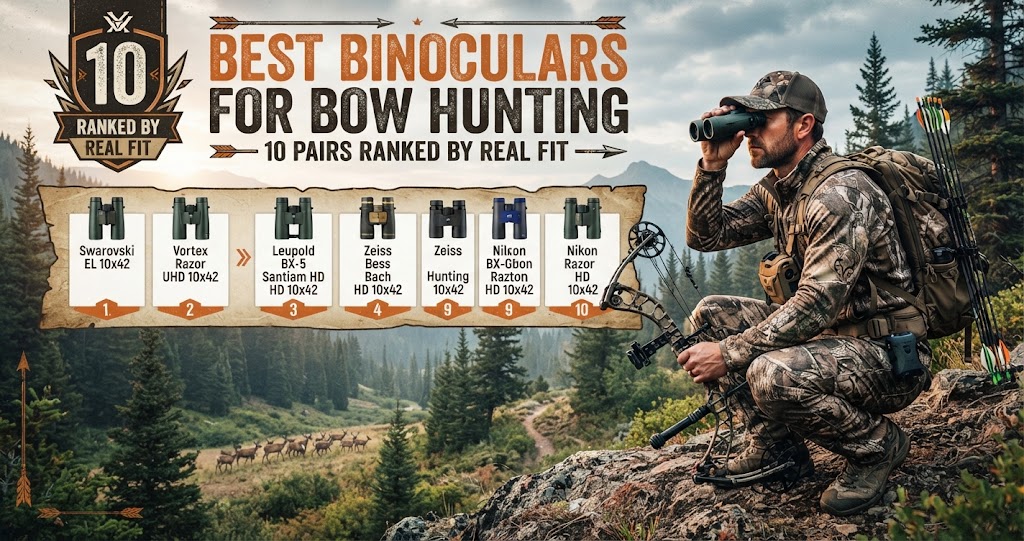
Affiliate disclosure: as an Amazon Associate we earn from qualifying purchases. Links to Amazon on this page are affiliate links, and they cost you nothing extra.
The best binoculars for bow hunting are 8×42 roof prism models with a wide field of view, an exit pupil near 5 mm and close focus under 15 feet. Of the ten pairs ranked here, the Athlon Midas UHD 8×42 fits best. By the end you will know which pair suits your stand, your eyes and your budget.
The best binoculars for bow hunting at a glance
Ranked by how well each pair fits archery ranges, not by price or power. Specs come from the makers and named retailers.
| # | Binocular | Size | Exit pupil | Field of view at 1,000 yd | Close focus | Weight | Weather sealing | Verdict |
|---|---|---|---|---|---|---|---|---|
| 1 | Athlon Midas UHD | 8×42 | 5.25 mm | 426 ft | 6.5 ft | 25 oz | Waterproof, argon purged | Best overall |
| 2 | Celestron Outland X 8×42 | 8×42 | 5.2 mm | 368 ft | 13.1 ft | 23.6 oz | Waterproof, fogproof | Best value |
| 3 | Celestron Outland X 8×25 | 8×25 | 3.1 mm | 432 ft | 16.4 ft | 11.5 oz | Waterproof, fogproof | Best compact |
| 4 | Celestron UpClose G2 10×50 | 10×50 | 5 mm | 354 ft | 23 ft | 27 oz | Water resistant only | Cheap low-light glass |
| 5 | Bushnell Falcon 10×50 | 10×50 | 5 mm | 300 ft | 25 ft | 27 oz | None | Fair-weather backup |
| 6 | Bushnell Powerview 10×25 | 10×25 | 2.5 mm | 300 ft | 21 ft | 8.5 oz | None | Pocket spare |
| 7 | Adorrgon 12×42 HD | 12×42 | 3.5 mm | 367 ft (claimed) | 11 ft | 16.7 oz | None | Weak optics |
| 8 | Steiner Marine 7×50 | 7×50 | 7.1 mm | 354 ft | 66 ft | 36.3 oz | Waterproof | Skip for archery |
| 9 | WOZEL 20×70 | 20×70 | 3.5 mm | Not published | Not published | About 42 oz | None | Skip for archery |
| 10 | Celestron SkyMaster 25×70 | 25×70 | 2.8 mm | 141 ft | 75 ft | 52 oz | Water resistant only | Skip for archery |
How we ranked these binoculars
We did not field test these ten pairs, and we will not pretend otherwise. BowsHunting.com ranked them from published specifications on the Celestron, Steiner and Athlon product pages, from B&H Photo and OpticsPlanet listings, and from OutdoorGearLab’s independent binocular test where one existed.
Ranking the best binoculars for bow hunting from specs alone has limits. Numbers cannot tell you how sharp the edges look or how the focus wheel feels with gloves on. They can tell you whether a pair is physically able to do the job at 20 yards in fading light, and four of these ten are not.
Each pair was scored on five things:
- Field of view, because a deer in timber is found with a wide picture, not a tight one.
- Exit pupil, because legal light at dawn and dusk is when deer move.
- Close focus, because many bow shots sit inside the minimum focus of long-range glass.
- Weight, because the pair rides on your chest all day.
- Weather sealing, because fogged lenses end a morning sit.
What is the best magnification for bow hunting?
Eight power is the right choice for most bowhunters, and 10x is the right choice for open country. Lower power gives a wider view, a brighter image at dusk and a steadier picture in one hand. Most bow shots happen inside 40 yards, so extra reach adds little and costs field of view.
8×42 vs 10×42 for bow hunting, in numbers
Both sizes share the same 42 mm front lens, so the difference comes down to simple arithmetic.
| Measure | 8×42 | 10×42 |
|---|---|---|
| Exit pupil | 5.25 mm | 4.2 mm |
| Typical field of view | About 7 degrees (367 ft at 1,000 yd) | About 6.4 degrees (335 ft at 1,000 yd) |
| Width of view at 30 yards | About 11 ft | About 10 ft |
| Hand shake | Magnified 8 times | Magnified 10 times |
| Twilight factor | 18.3 | 20.5 |
| Best use | Timber, stands, close shots | Open country, long glassing |
The field of view figures follow Bowhunter magazine’s comparison of the two sizes. The 8×42 delivers a quarter more light to your eye and a wider picture. The 10×42 shows a little more detail at distance, and it punishes a racing heartbeat harder.
Why high power fails at bow range
Field of view is the width of the scene a binocular shows, usually quoted in feet at 1,000 yards. Scale that number down to archery distance and the problem with big glass shows up fast.
At 30 yards, the Athlon’s 426 ft field covers a strip about 12.8 feet wide. The Celestron SkyMaster 25×70, with a 141 ft field, covers about 4.2 feet. A walking buck crosses that window in a step or two. This is why the best binoculars for bow hunting are rarely the most powerful ones on the shelf.
What specs matter most in a bowhunting binocular?
Four specs do most of the work: exit pupil, close focus, field of view and weight. Glass quality matters too, though it is the one thing a spec sheet shows least.
Exit pupil and low light
Exit pupil is the width of the beam of light leaving the eyepiece, found by dividing the front lens size by the magnification. An adult pupil opens to roughly 5 to 7 mm in dim light, so a pair near 5 mm fills the eye at dusk. A 10×25 gives 2.5 mm, which looks dim when deer start moving.
Twilight factor is a low-light score found by taking the square root of magnification times lens size. Treat it with care. The SkyMaster 25×70 scores 41.8, the highest here, yet its 2.8 mm exit pupil and 52 oz weight make it the worst pick for a stand. The formula rewards power and ignores whether you can hold the thing still.
Many states set legal shooting hours near half an hour either side of sunrise and sunset. Check your own state’s rules, then buy for that light.
Close focus
Close focus is the shortest distance at which a binocular can form a sharp image. Few guides to the best binoculars for bow hunting check it against shot distance, and it rules out two pairs here.
A deer at 20 yards stands 60 feet away. The Steiner Marine cannot focus closer than 66 feet, and the SkyMaster stops at 75 feet. Both would show a blur at a normal shot distance. The Athlon focuses down to 6.5 feet, so nothing inside bow range is too close.
Glass and prisms
ED glass is extra-low dispersion glass that cuts the color fringing seen around high-contrast edges, such as antler tines against a pale sky. Only the Athlon has it in this group.
BaK-4 is a dense prism glass that gives a rounder, brighter exit pupil than the cheaper BK7. A roof prism binocular has straight barrels and packs slim. A Porro prism binocular has offset barrels, which makes it wider and often cheaper for the same brightness.
Weight, eye relief and sealing
Eye relief is the distance your eye can sit behind the eyepiece and still see the full picture. Eyeglass wearers generally want about 15 mm or more. The Outland X 8×42 gives 17.8 mm and the Athlon 17.2 mm, while both Bushnell pairs give 9 mm.
A sealed pair is filled with dry nitrogen or argon so the inside cannot fog when you climb from a cold truck into a warm morning. Anything under about 27 oz carries well on a chest harness.e checked didn’t list the spec or disagreed.
The 10 pairs reviewed, best fit first
Here are all ten candidates for the best binoculars for bow hunting. Each review gives the verdict first, then the specs behind it. Amazon prices change daily, so follow the link for the current figure.
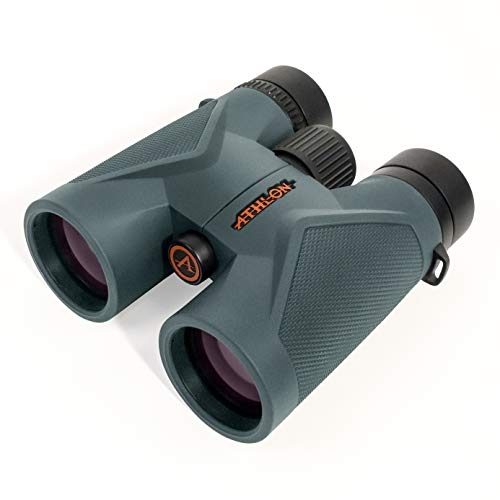
1. Athlon Midas UHD 8×42: best overall
Disclaimer: Prices are at time of the review and subject to change.
The Athlon Midas UHD is our pick as the best binoculars for bow hunting in this group, and it is not close. It pairs ED glass with phase-corrected, dielectric-coated BaK-4 prisms, which is the full coating stack you normally pay far more for.
B&H Photo lists a 426 ft field of view, a 5.25 mm exit pupil, 17.2 mm of eye relief and a 6.5 ft close focus at 25 oz. It is waterproof and argon purged. Athlon’s warranty page promises lifetime cover that transfers to a new owner with no receipt and no registration.
Best for: stand, blind and timber hunters who want one pair for years.
Skip it if your budget stops near $100.
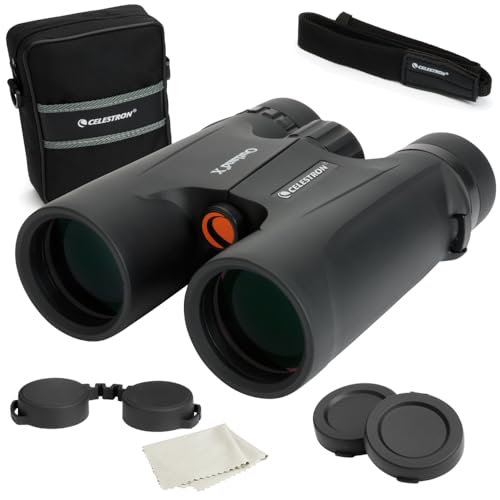
2. Celestron Outland X 8×42: best value
Disclaimer: Prices are at time of the review and subject to change.
The Outland X 8×42 gets you the right size, real sealing and long eye relief for about a third of the Athlon’s list price. Celestron’s product page lists BaK-4 prisms, multi-coated lenses, a 368 ft field, a 5.2 mm exit pupil and 17.8 mm of eye relief at 23.6 oz.
It is waterproof, fogproof and nitrogen filled. The trade-offs are honest ones: no ED glass, no phase coating listed, and a 13.1 ft close focus. Celestron names hunters among its intended users, and the limited lifetime warranty covers the original owner.
Best for: new bowhunters and eyeglass wearers on a budget.
Skip it if you want the sharpest glass at last light.
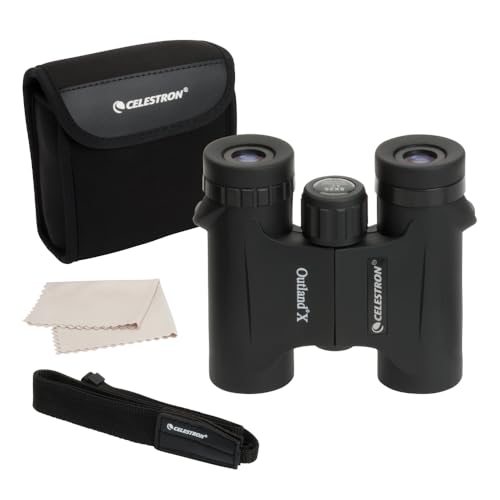
3. Celestron Outland X 8×25: best compact
Disclaimer: Prices are at time of the review and subject to change.
Among compact binoculars for bow hunting, the Outland X 8×25 stands out because it is sealed. Most pocket pairs at this price are not. Celestron lists 11.5 oz, a 432 ft field of view, BaK-4 prisms and nitrogen filling.
The cost is light. A 3.1 mm exit pupil is fine at midday and thin in the last ten minutes of legal light. Eye relief is 9.3 mm, which is short for glasses, and it will not mount on a tripod.
Best for: run-and-gun turkey and deer hunters, or a second pair in the pack.
Skip it if you hunt the edges of the day.
4. Celestron UpClose G2 10×50: cheap low-light glass
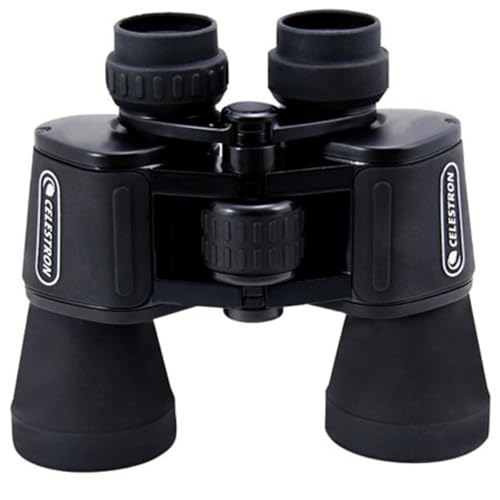
Disclaimer: Prices are at time of the review and subject to change.
The UpClose G2 10×50 is the least expensive way here to get a 5 mm exit pupil. Celestron lists a 354 ft field, multi-coated lenses and a tripod socket at 27 oz.
Three things hold it back. The prisms are BK7, the body is water resistant and not fogproof, and the 12 mm eye relief suits bare eyes only. Close focus is 23 feet, which still clears any bow shot.
Best for: dry-weather field edges on a tight budget.
Skip it if you hunt in rain or wear glasses.
5. Bushnell Falcon 10×50: fair-weather backup
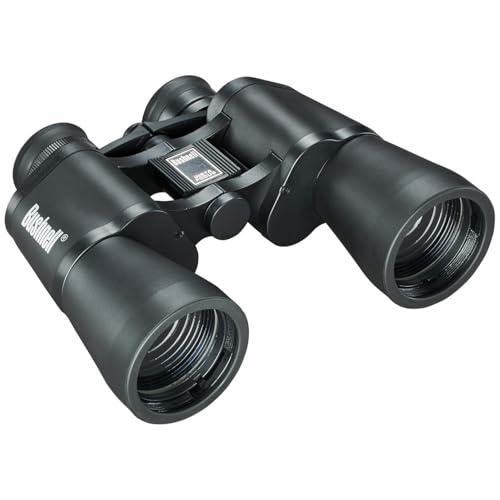
Disclaimer: Prices are at time of the review and subject to change.
The Falcon matches the UpClose on brightness and loses on width. Retailer listings show a 300 ft field of view, which is ordinary for a 10x despite the “Wide Angle” name, plus a 5 mm exit pupil and 27 oz weight.
Its InstaFocus lever is quick to work with one thumb. Eye relief is 9 mm, and we found no source that confirms waterproofing, so treat it as unsealed.
Best for: a truck pair you will not cry over.
Skip it if you need glass you can trust in fog or rain.
6. Bushnell Powerview 10×25: pocket spare
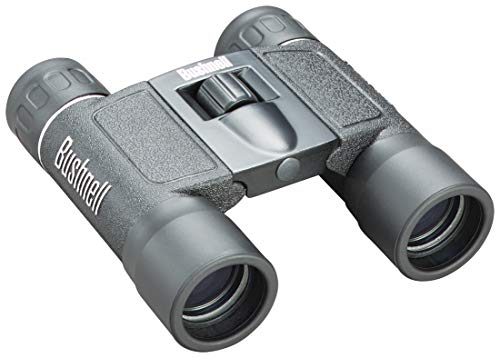
Disclaimer: Prices are at time of the review and subject to change.
At 8.5 oz, the Powerview disappears into a jacket pocket. That is its whole case. B&H Photo lists BK-7 prisms, fully coated lenses, a 2.5 mm exit pupil and 9 mm of eye relief.
It is neither waterproof nor fogproof, and 10x through a 25 mm lens is dim at dawn. B&H also marks this model as no longer available, so stock may be old.
Best for: midday scouting walks and a glove-box spare.
Skip it if this would be your only pair.
7. Adorrgon 12×42 HD: light, but weak glass
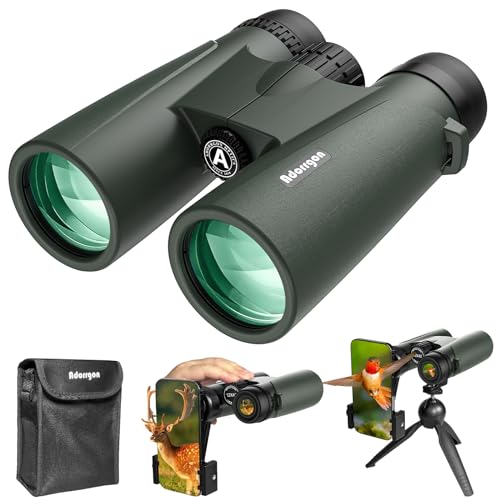
Disclaimer: Prices are at time of the review and subject to change.
The Adorrgon is light enough to hold and comes with a phone adapter and small tripod. The optics are the problem. OutdoorGearLab’s test scored it 40 out of 100 and ranked it 15th of 16 pairs, citing haze, color fringing and low brightness.
The same test measured 15 mm of eye relief against the 18.5 mm claimed, and ranked its field of view last. Twelve power also magnifies every tremor.
Best for: casual daytime viewing and phone photos.
Skip it if you hunt at first or last light.
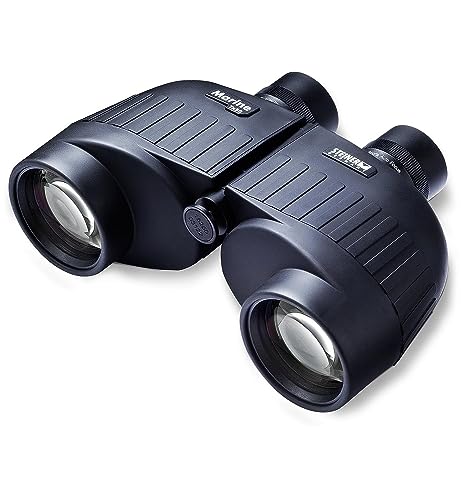
8. Steiner Marine 7×50: fine glass, wrong job
Disclaimer: Prices are at time of the review and subject to change.
The Steiner has the brightest view here, with a 7.1 mm exit pupil and 20.2 mm of eye relief. It is also built for boats. Steiner’s own page calls it a water-going binocular.
Two specs sink it for archery. Close focus is 66 feet, so a deer at 20 yards is out of focus. Its Sports-Auto Focus system has no center wheel, which means each eyepiece is set on its own. It weighs 36.3 oz.
Best for: boat owners who also sit a long bean field.
Skip it if you shoot inside 25 yards, which is most bowhunters.
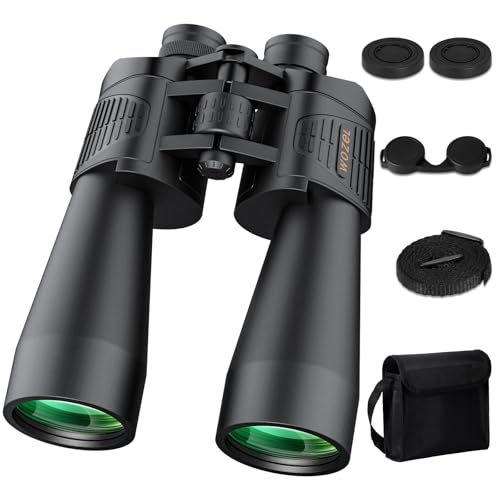
9. WOZEL 20×70: tripod only
Disclaimer: Prices are at time of the review and subject to change.
No honest list of the best binoculars for bow hunting should put a 20×70 near the top, though several competing guides rank similar pairs highly. At about 42 oz and 20 power, this one cannot be held steady by hand.
The listing describes it as not water resistant. We could not verify its field of view, close focus or warranty from any maker source, and that gap is a warning in itself.
Best for: glassing a far ridge from a tripod before the season.
Skip it if you plan to carry it to a stand.
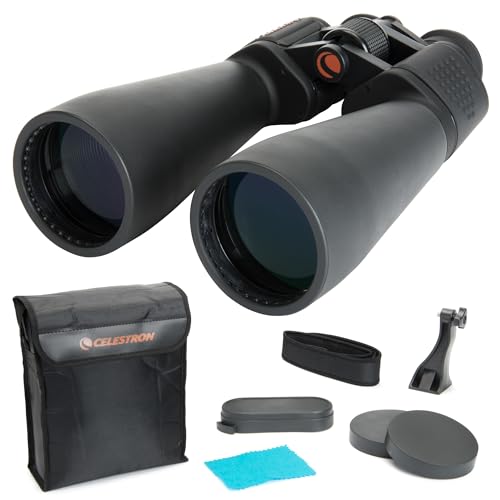
10. Celestron SkyMaster 25×70: built for the night sky
Disclaimer: Prices are at time of the review and subject to change.
The SkyMaster is a good astronomy binocular and the worst fit on this page. Celestron describes it as ideal for astronomical viewing or long-distance terrestrial use, and includes a tripod adapter for good reason.
It weighs 52 oz, shows a 141 ft field and cannot focus closer than 75 feet. In a tree stand it is dead weight.
Best for: stargazing and scouting open country from a truck window mount.
Skip it if you want something to wear while you hunt.
Which binocular fits your hunting style?
Match the pair to where you sit and how far you see. The best binoculars for bow hunting from a hardwood stand are the wrong ones for a sage flat.
| How you hunt | What matters most | Pick from this list |
|---|---|---|
| Tree stand in timber | Wide field, one-hand use, close focus | Athlon Midas UHD 8×42 |
| Ground blind | Low-light brightness, quiet handling | Celestron Outland X 8×42 |
| Run-and-gun or long hikes | Low weight, sealing | Celestron Outland X 8×25 |
| Field edges, dry weather, low budget | Exit pupil per dollar | Celestron UpClose G2 10×50 |
| Pre-season scouting from a tripod | Reach | Celestron SkyMaster 25×70 |
Binoculars for tree stand hunting
Tree stand glass gets used one-handed, with a bow in the other. That favors 8 power and a weight you can lift without thinking. Outdoor Life’s whitetail binocular test goes further and favors a compact 8×32 for bowhunters because it handles well in one hand. Neither Outland X will disappoint here.
Ground blinds and thick timber
Inside a blind you are looking from shade into shade, so exit pupil matters more than weight. An 8×42 is the safe choice. For evening sits, the best binoculars for bow hunting have a 42 mm lens, so leave pocket 25 mm pairs at home.
Spot-and-stalk and open country
Western elk and mule deer hunters glass farther, and 10 power earns its keep. None of the 10x pairs on this list is sealed well enough for mountain weather. If this is how you hunt, treat the list above as a guide to specs and buy a sealed 10×42.
Which budget binoculars for bow hunting are worth buying?
The Celestron Outland X 8×42 is the budget pair worth buying, because it is the cheapest one here with the right size and real weather sealing. Below it, every saving costs you either light or fog protection.
List prices we found on 2 October 2026, by tier:
- Under $75: Bushnell Powerview 10×25 (about $26 at Go Outdoor Gear), Celestron UpClose G2 10×50 ($51.95 at Celestron), Bushnell Falcon 10×50 ($59.99 at OpticsPlanet), Celestron Outland X 8×25 ($69.95 at Celestron).
- $100 to $150: Adorrgon 12×42 HD ($100 list, per OutdoorGearLab), Celestron Outland X 8×42 ($109.95 at Celestron), Celestron SkyMaster 25×70 ($139.95 at Celestron).
- $350 and up: Athlon Midas UHD 8×42 ($349.99 at Athlon), Steiner Marine 7×50 ($374.99 list at Steiner).
We could not confirm a list price for the WOZEL 20×70. Amazon often sells below list, so these figures are a ceiling, not a quote.
Here is our advice, and it is not what a listicle usually says. If you can spend about $110, buy the Outland X 8×42 and put the rest toward a harness. At BowsHunting.com we would sooner send you to a $110 pair that suits the job than a $375 pair that does not.
Key takeaways
- An 8×42 roof prism binocular is the right size for most bowhunters; 10×42 suits open country.
- The Athlon Midas UHD 8×42 is the best fit of these ten pairs, and the Celestron Outland X 8×42 is the best value.
- Check close focus before you buy. The Steiner Marine 7×50 and Celestron SkyMaster 25×70 cannot focus on a deer at 20 yards.
- Aim for an exit pupil near 5 mm and a sealed, gas-filled body for dawn and dusk sits.
- Skip 20x and 25x bow hunting binoculars unless they will live on a tripod.
BowsHunting.com will update this ranking as models and prices change. Ready to choose? See the Athlon Midas UHD 8×42 on Amazon, or start with the Celestron Outland X 8×42 if you are buying your first pair.
Frequently asked questions
Short answers to the questions bowhunters ask most.
Do you need binoculars for bow hunting?
Yes, for most hunts. Binoculars let you pick apart brush for an ear or antler tip, judge a deer before it is in range and watch a hit animal leave. They also keep you from using a rangefinder or a drawn bow to look at things. In thick cover a light 8x pair is enough.
Is 8x or 10x better for bow hunting?
Eight power is better for stands, blinds and timber. It gives a wider view, a larger exit pupil and a steadier image in one hand. Ten power is better where you glass past a few hundred yards. If you hunt both, the best binoculars for bow hunting are still an 8×42, because close shots are where archery seasons are decided.
Do you need a binocular harness for bow hunting?
A binocular harness for bow hunting is worth having with any full-size pair. It holds the glass flat on your chest, so it cannot swing into the bowstring or bang the stand when you draw. A neck strap does neither. Bowhunting.com’s harness roundup lists options from about $55 to $149.
Can you use binoculars with glasses?
Yes, if the eye relief is long enough. Look for about 15 mm or more and twist-up eyecups you can turn down. On this list the Celestron Outland X 8×42 (17.8 mm), the Athlon Midas UHD (17.2 mm) and the Steiner Marine (20.2 mm) qualify. The 9 mm Bushnell pairs will show a cropped picture through glasses.
Are waterproof binoculars necessary for hunting?
For bow season, close to it. The bigger risk is fog on the inside of the lens when cold glass meets warm, damp air. Pairs filled with nitrogen or argon cannot fog internally. Three models here are fully sealed that way: the Athlon Midas UHD and both Celestron Outland X sizes.
Are rangefinding binoculars worth it for bowhunting?
They can be, at a price. Rangefinding binoculars combine both tools so you move less before a shot. North American Bowhunter’s 2026 roundup lists its picks from about $800 to $3,000. None of the ten pairs on this page measures distance, so pair any of them with a separate rangefinder.
