



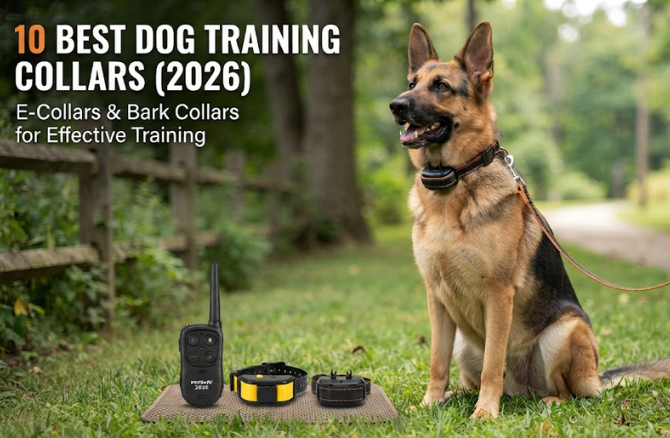
Three remote trainers and seven no-bark collars, sorted by what your dog actually needs, from the backyard to the duck blind.
The best dog training collars match one job a remote e-collar for recall and obedience at a distance, or an automatic bark collar for nuisance barking. Below you’ll find 10 picks with specs side by side, so you can choose the right collar type, size, and correction mode in one read.
Our Quick Picks
Each pick below is a current Amazon listing, chosen for a specific dog and job rather than ranked on one “overall” scale. Click a name to jump to its review.
Remote training collars (you trigger the cue)
- Best Remote E-Collar Overall: Jugbow 4500FT Dog Training Collar
- Best for First-Time E-Collar Owners: HapTop 4500FT Dog Training Collar with No-Shock Mode
- Best Remote Collar for Small Dogs: Bousnic 3300Ft Dog Training Collar
Bark collars (the collar triggers itself)
- Best No-Shock Bark Collar: DogRook Rechargeable Bark Collar
- Best for Fewer False Triggers: KJKZO Dog Bark Collar
- Best Bark Collar for Large Dogs: Smart Bark Collar with Intelligent Bark Recognition
- Best Long-Running Budget Brand: FAFAFROG Dog Bark Collar
- Most Sensitivity Settings (No Static): TC03PRO Smart Bark Collar
- Best Bark Collar for Small Dogs: PcEoTllar Dog Bark Collar
- Simplest Static-Option Bark Collar: Rechargeable Bark Collar with Beep, Vibration, and Shock
Side-by-Side Specs
This table compares the best dog training collars on this list at a glance. Every figure comes from the manufacturer’s own listing or manual. Where two listings for the same product disagree, we show the lower claim.
| Collar | Type | Dog size (listed) | Correction modes | Water rating (listed) |
|---|---|---|---|---|
| Jugbow 4500FT | Remote | 10–120 lb | Beep 1–8, vibration 1–16, static 1–99, static boost | IPX8 (receiver) |
| HapTop 4500FT | Remote | 10–120 lb | Beep 1–8, vibration 1–16, shock 0–99 (0 = no shock) | IPX8 (receiver) |
| Bousnic 3300Ft | Remote | 5–120 lb | Beep 1–8, vibration 1–16, shock 1–99 | IP67 (receiver) |
| DogRook | Bark | 12–110 lb | Beep, vibration (no shock) | IP67 |
| KJKZO | Bark | Small to large | 3 modes, 7 sensitivity levels | IP65–IP67 (varies by listing) |
| Smart Bark Collar (B0HCBT496J) | Bark | 10–150 lb | Beep, vibration, beep + vibration, static; 7 sensitivity | IP67 |
| FAFAFROG | Bark | Small to large | Up to 4 modes incl. static; 5 sensitivity | IP67 |
| TC03PRO | Bark | Small to large | Beep, vibration; 8 sensitivity | IP67 |
| PcEoTllar | Bark | Small to medium | Beep, vibration; 3 modes, 7 sensitivity | “Waterproof” (no rating on listing) |
| Rechargeable Beep/Vibration/Shock | Bark | Small to large | Beep, vibration, shock; 5 sensitivity | Not stated |
How We Chose the Best Dog Training Collars
We did not test these collars hands-on, and we won’t pretend otherwise. BowsHunting.com built this list from the manufacturers’ Amazon listings, their owner’s manuals where available, and cross-checks against the same products sold through other retailers.
Here is what we looked for:
- A correction ladder. Every pick offers beep or vibration below any static level, so you can start with the mildest cue.
- Stated safety features. Security locks on remotes, and automatic pause modes on bark collars that stop repeated corrections.
- Honest specs. When one product’s listings contradicted each other, we reported the more conservative number and said so.
- Clear wear rules. We favored brands that publish daily wear limits and repositioning guidance.
Replace this box with a verbatim answer from your trainer to: “What collar would you put on a first-time owner’s dog, and why?” Credit them by name, role, and years of experience. Delete this box if no answer is supplied.
Before You Use Any Training Collar
A training collar reinforces what your dog already knows. It does not teach a new command, and it works best alongside rewards.
The American Veterinary Society of Animal Behavior (AVSAB) recommends reward-based training and advises against aversive methods, including shock. You don’t have to use static at all to use the collars on this list. Every one of them offers beep or vibration, and several can run with static switched off.
If you do use static, climb the ladder in this order:
- Tone (beep) first, paired with a command your dog already knows.
- Vibration next, if the tone alone isn’t getting attention.
- The lowest static level your dog notices, found by starting at the bottom and moving up one step at a time.
A note on “shock collar” vs. e-collar: the two terms describe the same device. “E-collar” or “remote training collar” usually refers to a unit with adjustable levels plus tone and vibration, while “shock collar” is the older, blunter name that many listings still use for search reasons.
Wear limits matter more than most buyers realize. Jugbow, DogRook, and FAFAFROG all tell owners in their listings to keep the collar on for no more than 12 hours a day. DogRook adds that the collar should be repositioned every 2 to 4 hours. Leaving contact points in one spot all day is how skin irritation starts.
Remote Dog Training Collar Reviews
If you’re shopping for the best e collar for dogs on a budget, these three remote trainers cover most home and yard needs. Each pairs a handheld remote with a receiver collar, and all three offer beep, vibration, and adjustable static.
Jugbow 4500FT Dog Training Collar
Disclaimer: Prices are at time of the review and subject to change.
The Jugbow earns the top remote spot because it pairs a full correction ladder with the most complete safety and multi-dog feature set in this group. It offers beep (8 levels), vibration (16 levels), and static (99 levels), plus a static boost that adds about 10% intensity for moments when you need to break a dog’s focus fast.
One remote runs two dogs, and the remote stores each dog’s settings separately. That matters in a two-dog house you won’t accidentally hit a soft dog with a level set for a hard-headed one. The remote has a backlit color screen and a security lock to prevent accidental presses in a pocket.
Jugbow lists 35 days of standby time for the collar and 45 for the remote, with a two-hour charge. The receiver carries an IPX8 rating, and the brand recommends wearing it no more than 12 hours a day.
Pros
- Static boost for high-distraction moments
- Two-dog remote that remembers each dog’s settings
- IPX8-rated receiver
- Security lock on the remote
Cons
- The 4,500-foot range is an open-ground claim; expect far less in timber or hills
- 99 static levels is more than most owners need, so take care to start at the bottom
Key specs: 10–120 lb dogs · 7.8″–24.4″ necks · 2 channels · 35/45-day standby (collar/remote)
HapTop 4500FT Dog Training Collar with No-Shock Mode

Disclaimer: Prices are at time of the review and subject to change.
The HapTop’s standout feature is simple its shock scale starts at zero. Setting static to 0 turns this into a beep-and-vibration trainer, which is the right way for a new owner to start. You can add static later, one level at a time, if tone and vibration stop working.
It covers the same beep (1–8) and vibration (1–16) ranges as the Jugbow, with shock adjustable from 0 to 99. The IPX8-rated receiver fits dogs from 10 to 120 pounds with necks from 7.8 to 24.4 inches.
The trade-off is track record. This listing first appeared on Amazon in April 2026, so there is little long-term ownership history yet. The listing also doesn’t state battery life or whether one remote can run a second collar.
Pros
- True no-shock mode for beginners
- Full beep and vibration ladders
- IPX8-rated receiver
Cons
- New listing with a short ownership history
- Battery life and multi-dog support not stated
Key specs: 10–120 lb dogs · 7.8″–24.4″ necks · shock 0–99
Bousnic 3300Ft Dog Training Collar
Disclaimer: Prices are at time of the review and subject to change.
The Bousnic’s listed minimum of 5 pounds is the lowest of the three remote picks, which makes it the one to consider for a small terrier or a young, lightweight dog. It shares the same beep (1–8) and vibration (1–16) scales as the others, with shock from 1 to 99.
Dogster’s review of this model reports an IP67-rated receiver, battery life of up to 15 days on the receiver and over a month on the remote, both short and long contact prongs for different coats, and support for two dogs. Dogster also flags owner reports that the remote itself isn’t waterproof, so keep it dry during wet training sessions.
Its 3,300-foot claimed range is the shortest of the three remote picks, but that’s still more than any backyard or park session needs.
Pros
- Lowest listed minimum dog weight (5 lb)
- Two contact-prong lengths for short and long coats
- Two-dog capable
Cons
- Remote is reportedly not waterproof
- Shortest claimed range of the three remote picks
Key specs: 5–120 lb dogs · 3,300 ft claimed range · IP67 receiver
Bark Collar Reviews
A bark collar needs no remote. It senses barking and responds on its own, which makes it useful for kennel, crate, yard, and truck barking when you aren’t there to correct it. The best dog training collars in this group differ mainly in how they detect a bark and whether static is on the menu at all.
DogRook Rechargeable Bark Collar
Disclaimer: Prices are at time of the review and subject to change.
The DogRook uses only beep and vibration, with no static at all. That makes it the safest starting point for a sensitive dog or an owner who doesn’t want shock in the house. Its manual lists two vibration modes and seven progressive sound stages, a microphone tuned to the wearer’s bark, up to 14 days per charge, and an IP67 rating.
It has the longest history on this list Amazon shows it first became available in April 2017. That long run means years of owner feedback exist. Not every dog responds, though. Some owners report their dogs learn to bark through a correction that never escalates past vibration.
DogRook instructs owners to reposition the collar every 2 to 4 hours and keep total wear under 12 hours a day.
Pros
- No static, beep and vibration only
- Longest track record on this list (listed since 2017)
- Published repositioning and wear-time guidance
Cons
- Some stubborn barkers learn to ignore vibration
- One product-details line lists AAA batteries, which conflicts with “rechargeable” elsewhere on the page, so check before buying
Key specs: 12–110 lb dogs · IP67 · up to 14 days per charge
KJKZO Dog Bark Collar
Disclaimer: Prices are at time of the review and subject to change.
A bark collar that fires when another dog barks is teaching your dog the wrong lesson. KJKZO’s dual-sensor design responds to both bark sound and vocal-cord vibration, which is meant to keep it from reacting to other dogs, a TV, or background noise. The brand claims lab testing behind its false-trigger figures, which we couldn’t independently verify.
The safety feature we like most is the 7/1 pause after 7 consecutive barks, the collar rests for one minute. That caps how many corrections your dog can receive in a burst. It offers 3 modes and 7 sensitivity levels, weighs about 0.12 pounds, and charges over USB-C in about two hours, with 20-plus days claimed per charge. KJKZO backs it with a two-year warranty.
Pros
- Dual-sensor detection to reduce false triggers
- Automatic pause after 7 consecutive barks
- Very light at about 0.12 lb
Cons
- Water rating varies between listings (IP65 vs. IP67), so treat it as splash-proof, not swim-proof
- False-trigger claims are manufacturer data only
Key specs: 3 modes · 7 sensitivity levels · 20+ days per charge (claimed)
Smart Bark Collar with Intelligent Bark Recognition
Disclaimer: Prices are at time of the review and subject to change.
This collar lists the widest weight range on our bark list, up to 150 pounds, which puts it on the shortlist for big Labs, shepherds, and hounds. It offers four modes (beep, vibration, beep plus vibration, and adjustable static) with 7 sensitivity levels.
Two comfort details stand out for a big dog that wears it for hours soft silicone covers over the contact points and an automatic sleep mode. A digital display shows the current mode and setting at a glance. It carries an IP67 rating.
The listing doesn’t name a brand, and it doesn’t state battery life. If support matters to you, check the seller’s return and warranty terms before you buy.
Pros
- Widest weight range here (10–150 lb)
- Silicone contact-point covers
- Four modes, including static-free options
Cons
- No brand name or stated battery life on the listing
- Static mode needs careful, low-first setup
Key specs: 10–150 lb dogs · 4 modes · 7 sensitivity levels · IP67
FAFAFROG Dog Bark Collar
Disclaimer: Prices are at time of the review and subject to change.
FAFAFROG has been selling this model long enough that price trackers have followed it since May 2022, which gives it more ownership history than most bark collars on Amazon. It activates only when it detects both barking and vocal-cord vibration.
Its protect mode stops the collar for 30 seconds after 6 continuous activations, and the color display shows the working status and battery level. FAFAFROG lists a two-hour charge for about 15 to 20 days of use and an IP67 rating. The brand describes up to four working modes, from beep alone up to beep plus vibration plus static, with 5 sensitivity levels.
FAFAFROG’s listings also advise wearing the collar no more than 12 hours a day and moving it to a different spot on the neck each time.
Pros
- Years of sales history
- 30-second pause after 6 activations
- Color display for mode and battery
Cons
- Only 5 sensitivity levels, fewer than several rivals
- Mode options differ between listing variants, so confirm the one you buy
Key specs: 5 sensitivity levels · IP67 · 15–20 days per charge (claimed)
TC03PRO Smart Bark Collar
Disclaimer: Prices are at time of the review and subject to change.
Sensitivity decides how loud a bark has to be before the collar responds. With 8 sensitivity levels, the TC03PRO gives you the finest control on this list, which helps with a dog whose “real” barks and excited whines sit close together. It uses beep and vibration only.
It carries an IP67 rating. The manufacturer is listed as Quanzhou Purplebox Electronics, and the listing first appeared in June 2026, so long-term reliability is still an open question.
Pros
- 8 sensitivity levels
- No static, beep and vibration only
- IP67-rated
Cons
- Very new listing (June 2026)
- Few published details on battery life or wear guidance
Key specs: Beep + vibration · 8 sensitivity levels · IP67
PcEoTllar Dog Bark Collar
Disclaimer: Prices are at time of the review and subject to change.
This is the one bark collar on the list sized specifically for small and medium dogs, so it’s the pick for a vocal terrier or a small house dog rather than a 90-pound retriever. It uses beep and vibration across 3 training modes, with 7 sensitivity levels and an anti-false-trigger system.
It’s rechargeable and listed as waterproof, though this Amazon listing doesn’t state an IP rating. If your dog swims, pick a model with a published IP67 rating instead.
Pros
- Built for small and medium dogs
- No static, beep and vibration only
- 7 sensitivity levels
Cons
- No IP rating stated on the listing
- Not sized for large breeds
Key specs: Small–medium dogs · 3 modes · 7 sensitivity levels
Rechargeable Bark Collar with Beep, Vibration and Shock
Disclaimer: Prices are at time of the review and subject to change.
This collar keeps things basic beep, vibration, and shock, with 5 adjustable sensitivity levels, sold as a rechargeable unit for small, medium, and large dogs.
We’re being straight with you here the listing publishes less detail than any other pick on this page. It doesn’t state a water rating, battery life, or a weight range in its title. Choose it only if you want a plain three-mode collar and you’ve checked the seller’s return terms. For more published safety detail, the FAFAFROG or KJKZO is the better bet.
Pros
- Simple three-mode setup
- Rechargeable
Cons
- Fewest published specs on this list
- Includes shock with no stated pause or safety mode
Key specs: Beep, vibration, shock · 5 sensitivity levels
How to Choose a Dog Training Collar
Choosing between the best dog training collars starts with one question does your dog need you to send a cue, or does the collar need to react on its own? Recall, “leave it,” and off-leash obedience needs a remote collar. Barking when you’re not there needs a bark collar. If your dog does both, you may need one of each.
Then match the collar to the dog:
- Size first. Check the listed weight range, not just the photos. The Bousnic (5 lb minimum) and PcEoTllar suit small dogs; the Smart Bark Collar reaches 150 pounds.
- Temperament next. A soft or sensitive dog belongs in a no-static collar such as the DogRook, TC03PRO, or PcEoTllar. A hard-driving dog may need a remote with a wide static ladder, used from the bottom.
- Water exposure last. IPX7 and IP67 mean the device is rated for immersion to about one meter for 30 minutes. IPX8 goes beyond that, under conditions the manufacturer defines. IP65 only covers water jets, not swimming.
Advertised Range vs. Real-World Range
Every remote collar here claims 3,300 to 4,500 feet, and those figures assume flat, open ground. Sporting Dog Pro, a gun-dog equipment retailer, advises hunters to expect 40 to 60% of advertised range in timber, rolling hills, and creek bottoms. Budget accordingly a “4,500-foot” collar is a confident yard and park tool, not a guarantee in heavy cover.
Replace with the trainer’s verbatim answer to “How far do you really get from a collar’s advertised range in timber or hills?”
Choosing an E-Collar for Hunting Dogs
These budget remotes are strong choices for obedience work, yard training, and conditioning a young gun dog before the season. For an e-collar for hunting dogs that run big in cover, the job changes. Upland handlers often move to a beeper collar, which signals whether the dog is running or on point, or a GPS dog training collar that tracks the dog’s position on a handheld. Those purpose-built field systems from Garmin, SportDOG, Dogtra, and DT Systems cost more, because the handheld and collar are usually sold separately.
A quick guide by discipline:
| Your dog’s job | Collar that fits | Why |
|---|---|---|
| Waterfowl retriever | Remote e-collar with a published IPX7/IPX8 rating (e.g., Jugbow, HapTop) | Constant water work; the dog stays within sight |
| Close-working flusher | Remote e-collar | Short range, visual contact |
| Far-ranging pointer | Beeper or GPS field system | You need to find the dog on point |
| Blood-tracking dog | Long lead; GPS locator if the dog is ever released | Tracking is scent work, not a correction task |
| Barks in the kennel, truck, or blind | No-shock bark collar (DogRook, TC03PRO) | Automatic, and the lowest-stress option |
For bowhunters running a tracking dog on wounded deer: state rules on tracking dogs vary, including whether the dog must stay leashed. Check with your state wildlife agency before you track.
Replace with the trainer’s verbatim answer to “Do you use collars differently for pointers, flushers, retrievers, or blood-tracking dogs?”
Before You Start Training With a New Collar
Even the best dog training collars fail without a proper introduction.
Check your dog’s age. Remote training collars generally aren’t intended for dogs younger than six months, and DogRook’s manual specifies healthy dogs over six months and at least 8 pounds. Start puppies with basic obedience instead.
Fit it correctly. The contact points need to touch skin, so the collar should be snug but not tight. Use the longer prongs that some models include for thick or long coats.
Let the dog wear it before you use it. Put the collar on during walks, fetch, and meals for several days without pressing a button. A dog that links the collar with good things won’t learn to behave only when it’s wearing one.
Run a test. Check the lowest setting on yourself or with any included test light before you use it on your dog.
Consult your vet if your dog has a neck, throat, or skin condition.
Replace with the trainer’s verbatim answers to “How do you introduce an e-collar to a young dog?” and “What’s the most common e-collar mistake you see new owners make?”
Final Thoughts on the Best Dog Training Collars
Key takeaways:
- The best dog training collars match one job a remote collar for cues at a distance, a bark collar for automatic bark control.
- The Jugbow is our top remote pick for its two-dog memory, static boost, and IPX8 receiver; the HapTop’s zero-shock setting suits first-timers.
- For barking, the DogRook is the safest start (no static, long track record), and the KJKZO offers the strongest false-trigger and pause protections.
- Start every collar at beep or vibration, and limit wear to 12 hours a day.
- Treat advertised range as a best case; expect far less in heavy cover.
Pick the collar that fits your dog’s size and temperament from the table above, and check its current price on Amazon before you buy.
Why Trust Us
Replace with BowsHunting.com’s real credentials who writes and edits the site, their hunting and dog-handling experience, and how long the site has covered gear. Do not publish invented experience.
BowsHunting.com compiled this guide from manufacturer listings and manuals, cross-checked specs across retailers, and flagged every contradiction we found. We’ll update our list of the best dog training collars as listings change and as our trainer contributors add field notes.
Also Read: Best Compact Binoculars for Hunting, Travel & Kids
Also Read: Best Compound Bows for Beginners and Hunters
Also Read: Best Crossbows of 2026: 10 Amazon Picks, Honestly Sorted
FAQs
Are e-collars cruel?
Not when used correctly. Most owners and trainers who rely on e-collars consider them humane, because modern units offer tone and vibration and let you use the lowest level that works. Misused, with high static, bad timing, or as a punishment for commands the dog never learned, they can cause fear and stress. AVSAB recommends reward-based methods over any aversive, so the most humane approach is to start with rewards and use the collar’s non-static cues first.
Prong collar vs. e-collar which is better?
They solve different problems. A prong collar is a leash tool that discourages pulling through even pressure around the neck, so it only works while the dog is on a leash beside you. An e-collar works at a distance, which makes it the better tool for recall and off-leash obedience.
Do professional dog trainers use e-collars?
Many do, especially gun-dog, working-dog, and off-leash obedience trainers who need to reach a dog at a distance. Many others train without them. The split usually comes down to the dog’s job and the trainer’s methods.
Can you use an e-collar in the house?
Yes. Many owners use the tone or vibration setting indoors for behaviors like counter-surfing or door-dashing. Keep indoor sessions short, and use the lowest setting that gets your dog’s attention.
Can a hunting dog wear a bark collar?
Yes, for kennel, truck, or blind barking, a no-shock model is the lowest-stress choice. Take it off for active hunting and water retrieves, since excitement barking during the work isn’t a behavior you want to correct automatically.
Is a harness or a training collar better?
A harness is better for comfort and for dogs with neck or throat concerns, especially during long walks. A training collar is better for communicating corrections and cues. Many owners use both a harness for everyday walks and a training collar for sessions.
Samsung Demo Phone
The Samsung Demo Phone currently tops our rank of the greatest Samsung phones available, beating even the pricier iPhone Ultra Max Mega.
So unsurprisingly this is an absolutely fantastic phone. The design isn't massively changed from the previous generation, but most other elements have been upgraded. This is what we call a big boost.
-
Display
-
Performance
-
Features
-
Usability
-
Battery Life
