



This guide contains Amazon affiliate links. As an Amazon Associate we earn from qualifying purchases, at no extra cost to you.
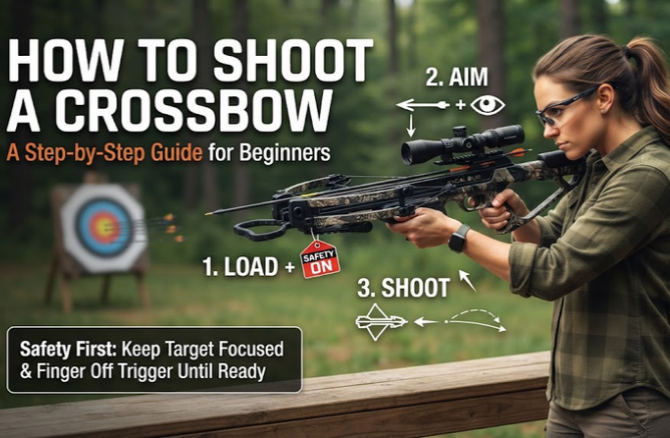
To shoot a crossbow, cock the string with a rope or crank, load one arrow with the odd-colored vane down, shoulder the stock, aim through the scope, switch the safety off and squeeze the trigger slowly. This guide shows you how to shoot a crossbow safely, sight it in and fix the misses most beginners make.
BowsHunting.com built this guide from manufacturer manuals, the National Bowhunter Education Foundation (NBEF) course and published testing. We have not range-tested this gear ourselves, so every specific number below names its source.
What do you need before your first shot?
A crossbow is a horizontal bow mounted on a stock that holds its string at full draw with a latch until the trigger releases it. That stored energy is why the setup matters as much as the shot. Have these six things ready:
- Arrows that match your manual. Use the length, weight and nock type the manufacturer lists. Field & Stream notes that crossbows use either moon nocks or flat nocks, and the wrong one can fail to seat.
- Field points in the same weight as the broadheads you plan to hunt with.
- A crossbow-rated target. The NBEF course says to use only targets or backstops approved for crossbows, because a hunting crossbow will shoot through a light archery bag.
- A cocking aid. A rope cocker or a crank, covered below.
- Safety glasses. The NBEF course lists them first in its shooting steps.
- Rail lube and string wax. Most packages include a tube.
Then spend two minutes on inspection. Look for cracks in the limbs and fraying on the string, especially the center serving where the arrow sits. Check that the limb and scope bolts are tight. Flex each arrow and look at its nock, and set aside any shaft that is splintered or bent.
Crossbow safety rules to know first
A crossbow’s limbs and string move with enough force to break bones, so anyone learning how to shoot a crossbow should learn the safety rules before the shooting steps. Seven rules prevent nearly every injury the ranking guides warn about:
- Never dry fire. A dry fire is releasing the string with no arrow loaded, which sends all the stored energy back into the limbs.
- Keep fingers and thumb below the rail. The NBEF course warns that a digit left in the string’s path will be seriously injured.
- Clear the limbs. The limb tips snap forward on release. Keep them away from tree trunks, blind windows and bystanders.
- Leave the safety on until the sights are on target, and keep your finger off the trigger until then.
- Point it in a safe direction, even when it is cocked with no arrow loaded.
- Know what is behind the target. An arrow that misses keeps going.
- Cock on the ground, not in a tree stand. Load only once you are settled, and raise or lower the bow on a haul line with no arrow on the rail.
How to cock a crossbow
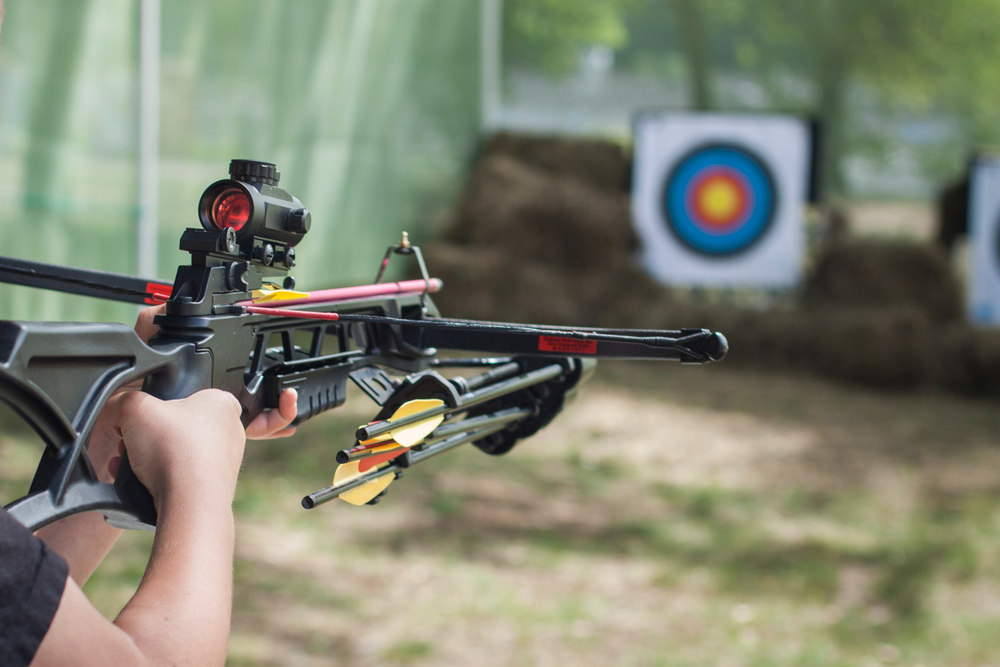
Cocking is drawing the string back until the latch catches it, and it always comes before loading. The string has to sit dead center in the latch. Field & Stream reports that a string cocked as little as 1/8 inch off center can move the arrow’s impact by several inches.
Check your manual for the safety position first. The NBEF course notes that many crossbows need the safety on “fire” before the string will latch, and that some engage the safety automatically once cocked while others need you to do it.
Using a rope cocker
A rope cocker is a rope with two handles and two sliding hooks that cuts the pulling effort roughly in half. It is the standard aid included with most packages.
- Point the bow at the ground and put your foot firmly through the stirrup.
- Lay the middle of the rope in the groove behind the scope rail.
- Hook both hooks on the string, tight against each side of the rail.
- Pull both handles up evenly in one smooth motion until the string clicks into the latch.
- Confirm the safety is on, then remove and stow the rope.
Using a crank
A crank is a small winch, built into the stock or attached to it, that winds the string back for you. It is slower than a rope but takes very little strength. TenPoint lists its ACUslide crank on the TenPoint Turbo X at about 5 pounds of cranking force. Turn the handle until the string latches, then confirm the safety.
Should you cock by hand?
The ranking guides disagree here. Several teach hand cocking first, while Shooting Time tells readers not to do it at all. For a beginner, we side with not doing it.
Modern hunting crossbows are heavy to draw. Barnett lists 190 pounds for its Hyper Whitetail 410, and Killer Instinct lists 220 pounds for the Boss 405. Pulling that evenly with bare hands is hard, and an uneven pull is exactly what throws arrows sideways. The NBEF course makes the same point: a cocking aid gives consistent string placement.
Loading the arrow
Learning how to load a crossbow takes a minute, and it is the step where most hand injuries are avoided.
- Hold the arrow just behind the point. NRA Family advises never letting your hand cross the string’s path while loading.
- Turn the odd-colored vane down so it rides in the rail groove.
- Slide the arrow back under the retention spring until the nock touches the string.
- Look, don’t assume. A gap between nock and string causes a partial dry fire.
Most new crossbows have an anti-dry-fire mechanism that blocks the trigger when no arrow is seated. Treat it as a backup. Pyramyd Air’s crossbow guide points out that these systems are mechanical and can fail.
How to aim a crossbow
Bring the stock to your shoulder and your cheek to the stock, then look through the scope. In a multi-line scope the top line or dot is normally the 20-yard mark, and each line below it is for a longer distance. TenPoint’s sight-in instructions use the top line at 20 yards for this reason.
Hand placement and grip
Your front hand supports the foregrip from underneath, with every finger and your thumb below the rail. Many stocks have finger guards or a pass-through grip to keep them there. Your trigger hand holds the grip lightly. Whatever pressure you use, use the same pressure on every shot.
Stance, cheek position, and rest
Stand with your feet about shoulder width apart and your trigger-side foot slightly back. Put your cheek on the same spot of the stock each time, because moving your eye moves the point of impact.
Keep the limbs level. A crossbow tilted to one side sends arrows off to that side, and the error grows with distance. Crossbow Magazine suggests adding a small scope level if you struggle with this.
Use a rest whenever you can. The NBEF course says a crossbow can be fired resting on an object for greater accuracy. Grand View Outdoors adds one caution: put your hand or something soft between the forearm and a hard rail, or the bow bounces and shoots high.
How to shoot a crossbow: trigger, breathing, and follow-through
The shot itself takes a few seconds. This sequence combines the NBEF course steps with TenPoint’s shooting instructions:
- Check the limbs are clear on both sides.
- Settle the 20-yard reticle on a small spot, not the whole target.
- Push the safety to “fire.”
- Breathe. Take a deep breath and let about half of it out.
- Squeeze. Press the trigger straight back with the pad of your finger, slowly, until the bow fires. A slow press should surprise you a little.
- Follow through. Keep your cheek down and the reticle on the spot until the arrow hits.
Step six is the one beginners skip. The NBEF course explains that the arrow takes time to leave the bow, so relaxing the moment the trigger breaks makes the arrow strike low. If you remember only one thing about how to shoot a crossbow, make it this: hold your aim until you hear the arrow land.
How to sight in a crossbow
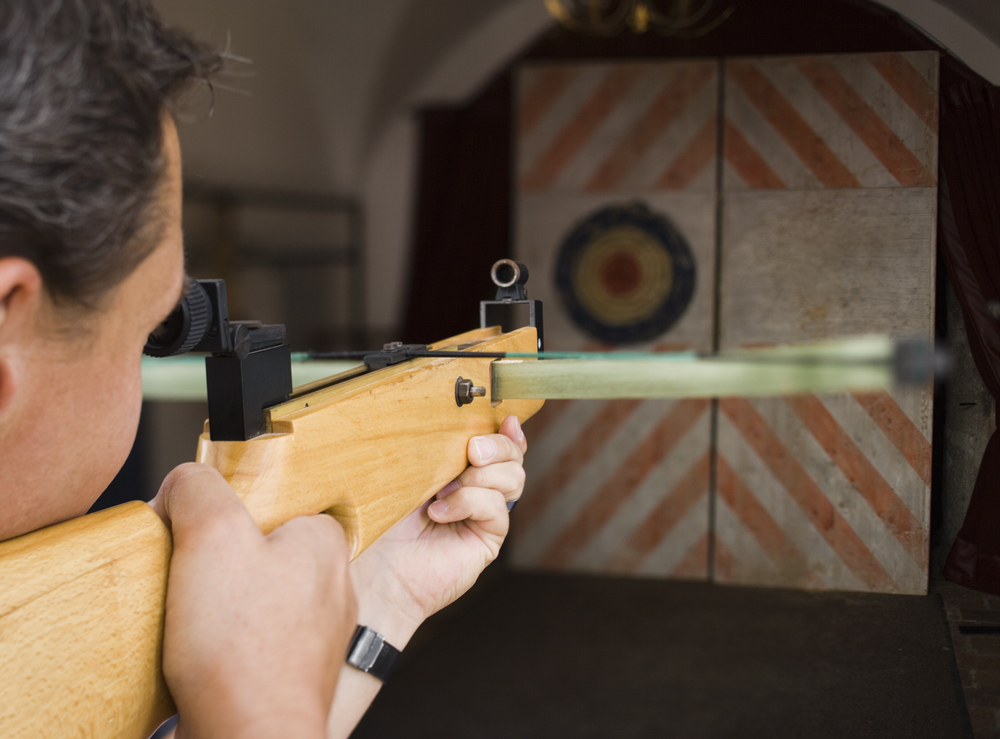
Sighting in is adjusting the scope so the arrow lands where the reticle points. TenPoint says its crossbows leave the factory bore sighted at 20 yards, but every bow still needs checking with your arrows.
- Shoot from a solid rest. The NBEF course recommends a bench or support for sighting in.
- Start at 10 yards. Killer Instinct’s sight-in guide starts here so the first arrows land on the target.
- Move to 20 yards and shoot three arrows using the top reticle. You are looking for a group, not a bullseye. Best Crossbow Source suggests waiting until your arrows land within 2 to 3 inches of each other before touching the scope.
- Adjust the turrets. The top turret moves impact up and down, and the side turret moves it left and right. Scheels’ guide gives the rule for scopes: turn in the direction you want the arrows to move, following the arrows printed on the turret.
- Shoot another group and repeat until the group sits on your aiming spot.
- Check the lower reticles at 30 and 40 yards. If your scope has a speed dial, set it to your bow’s speed before you start and leave it alone afterward.
Click values vary by scope. Killer Instinct says about 16 clicks moves impact 1 inch at 20 yards on its scope, so read your own scope’s manual before counting.
Expect a small arc even at short range. Field & Stream reports that a bow zeroed at 20 yards typically hits 1 to 2 inches high at 15 yards and 2 to 3 inches low at 25. Before hunting, the NBEF course says to repeat the process with the same broadheads and shafts you will hunt with.
What should your first practice session look like?
Most guides on how to shoot a crossbow stop at the trigger pull and give no first-day plan, so here is one built from the distances above. It takes about 25 shots.
| Stage | Distance | Shots | Goal |
|---|---|---|---|
| 1 | 10 yards | 3 | Run the full cock, load and shoot routine without rushing |
| 2 | 20 yards | 9 (three groups of 3) | Adjust the scope between groups until the group is centered |
| 3 | 20 yards | 6 | One arrow at each of six separate dots, to confirm the zero |
| 4 | 30 yards | 6 (two groups of 3) | Learn the second reticle |
Stage 3 uses separate dots for a reason. Grand View Outdoors notes that a sighted-in crossbow is accurate enough to hit and damage its own arrows when you keep aiming at one spot.
Stop when your groups start to widen. That is usually fatigue, and practicing tired teaches bad habits. Shooting Time recommends re-tightening the bolts on the bow after every 50 to 100 arrows.
How to shoot a crossbow accurately when your arrows miss
Misses follow patterns, and the pattern usually points to the cause. No competing guide lays these out, so this table gathers the causes the sources above describe:
| What you see | Likely cause | Fix |
|---|---|---|
| Arrows hit low on a sighted-in bow | Dropping the bow or lifting your head before the arrow clears the rail | Hold your aim until the arrow lands |
| Every arrow lands left, or every arrow lands right | String cocked off center, or windage not zeroed | Re-cock with a rope or crank and check the string is centered, then adjust windage |
| Arrows scatter with no pattern | Jerking the trigger or changing your grip between shots | Slow the squeeze and shoot from a rest |
| Arrows hit high from a rest | Forearm sitting on a hard surface | Pad the rest with your hand or a glove |
| Good at 20 yards, sideways at 40 | Limbs tilted | Level the bow, and add a scope level if needed |
| Good with field points, off with broadheads | Broadheads fly differently | Re-zero with your hunting broadheads |
| One arrow always strays | A bent shaft or damaged nock | Number your arrows and retire the one that strays |
Work from the top of the table down. Fix follow-through and string centering before you touch the scope, or you will end up adjusting the sight to match a mistake.
How do you unload a crossbow when you are done?
Take the arrow off the rail any time you walk, climb or hand the bow to someone. A cocked crossbow with no arrow is still under full tension, so it also has to be uncocked when you finish for the day.
The NBEF course calls shooting an arrow into a safe backstop the safest way to do this. Swap your hunting arrow for one with a field point and fire it into a discharge target or soft ground. The same course warns against using cocking ropes or special unloading arrows to uncock unless your manufacturer recommends them.
Some crossbows are built to de-cock without a shot. TenPoint says the ACUslide system on the Turbo X does this. Our guide to uncocking a crossbow without shooting walks through each method.
Afterward, wax the string and cables but skip the center serving, and put a light line of lube on the rail. Shooting Time’s maintenance checklist recommends doing both each time the bow has been cocked.
Which crossbows make learning easier?
When you are still working out how to shoot a crossbow, the bow itself can make the job easier or harder. The right crossbow for beginners is one you can cock the same way every time and trust not to fire empty. Three features do most of that work: a cocking aid you find easy to use, an anti-dry-fire system and a clean trigger. In our view, a new shooter gains more from a crank and a crisp trigger than from an extra 50 feet per second.
BowsHunting.com has not shot these models. The table compares specs published by the manufacturers and major retailers, checked in October 2026. Confirm them on the listing before you buy, since packages change.
| Crossbow | Listed speed | Cocking | What helps a learner |
|---|---|---|---|
| Barnett Whitetail Hunter II | 350 fps | Rope cocker included; crank compatible | 150-pound draw, the lightest full-size bow here; anti-dry-fire trigger |
| Barnett Recruit Youth | 195 fps (60-pound version) | Rope cocker included | Sized for youth and smaller shooters; adjustable stock; anti-dry-fire trigger |
| TenPoint Turbo X | 415 fps | ACUslide crank, about 5 pounds of force | De-cocks without firing a shot |
| TenPoint Titan | 400 fps (Titan 400) | Built-in crank | Low-effort cocking in a 6-pound bow |
| Killer Instinct Boss 405 | 405 fps | Rope | Six-position adjustable stock fits different arm lengths |
| Wicked Ridge Commander M1 | 380 fps | ACUdraw crank on this package | 5.8 pounds, the lightest hunting bow here |
| Barnett Hyper Whitetail 410 | 410 fps | Rope sled included | Anti-dry-fire trigger with nock sensors; 3-pound trigger |
| Xpedition Xtraction 400X | 400 fps | Rope cocker included | Anti-dry-fire trigger; narrow frame |
| Ravin crossbow package | Varies by model | Built-in cocking mechanism | Ships assembled and pre-tuned; automatic safety |
| Barnett Hyper Raptor | 410 fps | Rope sled included | Safety engages automatically when cocked; 3-pound TriggerTech trigger |
Three quick ways to narrow it down:
- If cocking strength is your worry, look at the crank models: the Turbo X, the Titan, the Commander M1 and the Ravin.
- If you want the gentlest full-size bow, the Whitetail Hunter II has the lowest draw weight and takes a crank later.
- If the shooter is a child or small-framed, the Recruit Youth is built for that.
For younger kids who are not ready for a real bow, the Barnett Phantum is a toy that fires suction-cup darts. Barnett lists its range at just over 30 feet. It teaches aiming and safe handling habits, and it is not a hunting tool.
Key takeaways
- Cock with a rope or crank so the string sits centered, and confirm the safety is on.
- Load one arrow with the odd-colored vane down and the nock touching the string.
- Keep every finger below the rail and the limbs clear of obstacles.
- Squeeze the trigger slowly on a half breath, and hold your aim until the arrow lands.
- Zero at 20 yards from a rest, then check 30 and 40.
- Never dry fire, and uncock by shooting a field-point arrow into a safe backstop.
That is how to shoot a crossbow well: a routine you repeat the same way every time. Set a target at 10 yards this week and run the four-stage practice plan above.
Frequently asked questions
How far can a crossbow shoot?
A hunting crossbow can throw an arrow hundreds of yards, but that is not its useful range. TenPoint puts the effective hunting range for most shooters at about 40 yards, and Field & Stream advises keeping shots on deer to 30 yards and under. As a beginner, practice at 20 and 30 yards until your groups are tight.
Can you dry fire a crossbow?
No. With no arrow to absorb the energy, the limbs, string and cams take all of it, which can crack limbs and injure the shooter. Anti-dry-fire mechanisms reduce the risk but do not remove it. If a dry fire happens, stop shooting and have a pro shop inspect the bow before you cock it again.
What distance should you look at a crossbow?
Zero the top reticle at 20 yards. Most multi-line crossbow scopes are designed around a 20-yard top mark, with lower marks for 30, 40 and beyond. Start at 10 yards only to get your first arrows on the target, then move back.
How long can you leave a crossbow cocked?
Only as long as you are actively shooting or hunting that day. The NBEF course says never to leave a crossbow cocked for an extended period and to follow your manual for limits. Uncock it at the end of every session, and never store or transport it cocked.
Do you need to practice with broadheads?
Yes, before hunting. The NBEF course says to sight in with broadheads and shafts identical to your hunting setup, because impact can shift from field points. Learn the routine with field points first, then confirm your zero with broadheads on a broadhead-rated target.
Can you shoot a crossbow from a tree stand?
Yes, with two changes. Cock the bow on the ground, then raise it on a haul line with no arrow loaded. Load once you are seated and strapped in. Before each shot, check that the limbs will clear the tree, the rail and your stand.
Before you click away, disappointed that I brought up something as practical and boring as time management, hear me out. My intent is not to crush your spirits.
To its detractors, love at first sight must be an illusion – the wrong term for what is simply infatuation, or a way to sugarcoat lust.
- Take a social media hiatus. According to a recent survey from everyday health, why not dial that back for the holidays?
- Stick to your new routine. It’s tempting to shake up your typical schedule when the holidays come around, but women’s health expert.
- Be intentional about fitness. If working out is a de-stressor for you 365 day.
Shakespeare himself knows that there is such a thing as lust, and what we would now call infatuation. He’s no fool. People who exhibit the perfectionism are fearful of failure.
Samsung Demo Phone
The Samsung Demo Phone currently tops our rank of the greatest Samsung phones available, beating even the pricier iPhone Ultra Max Mega.
So unsurprisingly this is an absolutely fantastic phone. The design isn't massively changed from the previous generation, but most other elements have been upgraded. This is what we call a big boost.
-
Display
-
Performance
-
Features
-
Usability
-
Battery Life
