Affiliate disclosure: this guide contains Amazon links. As an Amazon Associate, we earn from qualifying purchases at no extra cost to you.
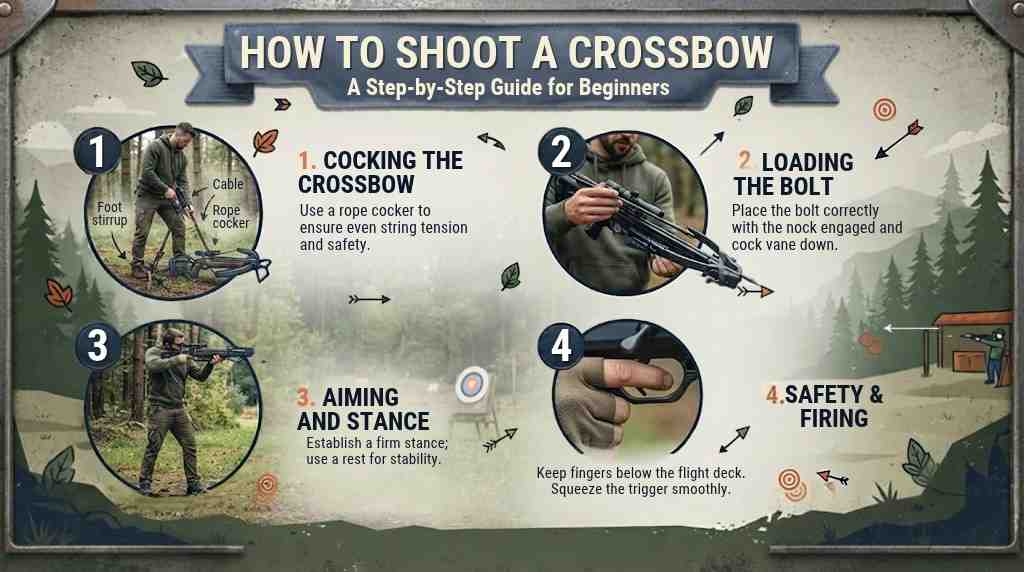
To shoot a crossbow, cock the string until it latches, set the safety, seat a bolt against the string, shoulder the stock on a steady rest, aim through the scope, then squeeze the trigger and hold still until the bolt lands. This guide on how to shoot a crossbow takes you from first inspection to a tight 20-yard group.
How to shoot a crossbow: the full sequence at a glance
A crossbow is a bow mounted sideways on a rifle-style stock that holds its own string at full draw until you pull a trigger. Because the latch does the holding, accuracy comes from doing eight small things in the same order every time.
- Inspect the limbs, string, bolts, and scope mounts.
- Cock the string evenly until it latches.
- Confirm the safety is on.
- Load a bolt with the odd-colored vane down.
- Shoulder the stock and settle onto a rest.
- Aim with the right reticle for the distance.
- Squeeze the trigger while you exhale.
- Follow through, then decock when you finish.
BowsHunting.com built this sequence by comparing hunter-education course material with manufacturer instructions, step against step. We did not range-test the crossbows named later, so product details come from published listings and reviews.
Crossbow safety rules to learn first
Anyone learning how to shoot a crossbow should start with safety. Kalkomey’s Hunter Ed course says safe crossbow use means following the rules for both firearms and bows. Four habits prevent most injuries:
- Keep fingers and thumb below the rail. The string travels along the top of the stock. Field & Stream’s beginner crossbow guide warns against wrapping a thumb over the forearm for exactly this reason.
- Never dry fire. A dry fire is the release of a cocked crossbow with no bolt seated, which sends the stored energy into the limbs and string.
- Keep the limbs clear. The Bowhunter Ed course warns that limb tips snap forward hard enough to break on a tree, or to hurt a bystander.
- Point it downrange whenever it is cocked, loaded or not.
Read the owner’s manual before the first shot. Safety positions, cocking steps, and approved bolts differ by model, and the manual overrides any general guide. That includes this one.
What should you check before every shot?
Check four things before you cock: limbs, string, bolts, and fasteners. Look for cracks or splinters in the limbs, fraying or loose serving on the string, bent or splintered bolt shafts, and loose scope or stock screws. A fault in any one of them can turn a normal shot into a broken bow.
The serving is the tight thread wrap at the center of the string where the latch grips. It takes the most wear, so look there first. ShootingTime’s crossbow guide recommends retightening every bolt on the bow after each 50 to 100 shots, because vibration backs them out.
One habit pays off all season. Outdoor Life’s cocking advice is to mark the serving on both sides of the rail while the string is at rest. After you cock, the two marks tell you at a glance whether the string is centered.
How to cock a crossbow: hand, rope, or crank
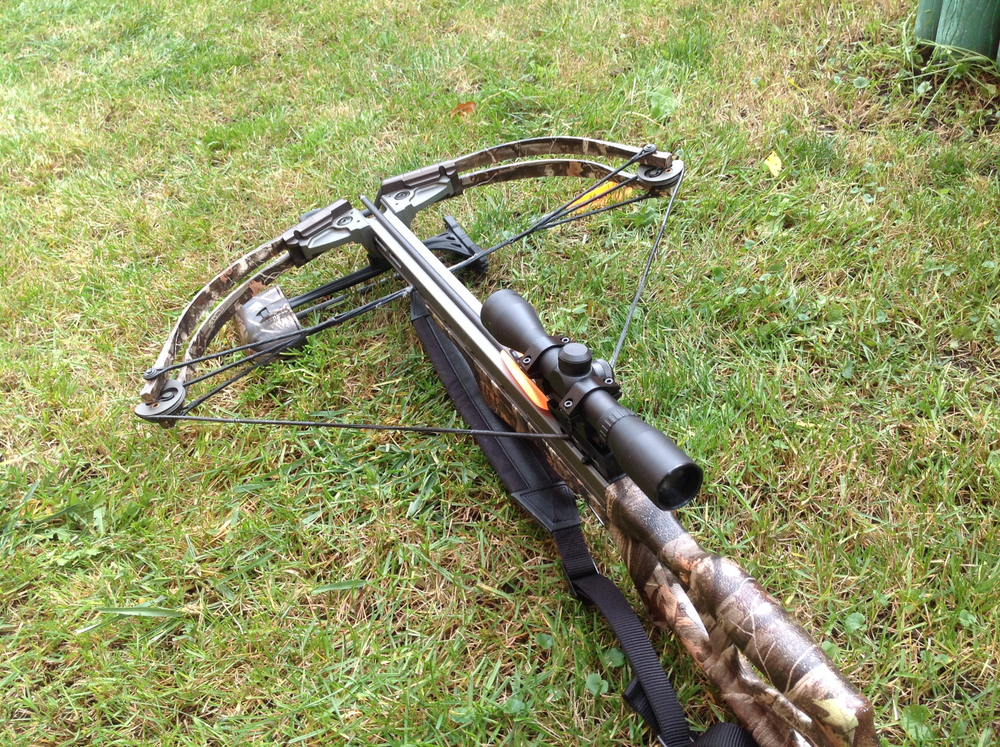
To cock a crossbow, point it at the ground, put the ball of your foot in the stirrup, and draw the string straight back with equal pull on both sides until it clicks into the latch. Then confirm the safety is on. The stirrup is the metal loop at the front of the bow that your foot pins to the ground.
Even pull matters more than strength. Field & Stream’s beginner crossbow guide notes that a string latched as little as 1/8 inch off center can move the point of impact by several inches.
| Cocking method | Effort | Speed | Main drawback |
|---|---|---|---|
| By hand | Full draw weight | Fastest | Hardest to keep centered |
| Rope cocker | About half the draw weight | Moderate | Needs a long, full-height pull |
| Crank | Lowest, often under 10 lb | Slowest | Costs more and can be noisy |
The effort figures come from ShootingTime’s crossbow guide, which gives the example of a 160 lb bow needing about 80 lb of pull with a rope. Field & Stream adds the catch: a rope halves the effort by doubling the distance you pull.
Our pick for a first crossbow is the rope. It costs little, and the Bowhunter Ed course notes that a cocking aid gives consistent string placement, which hands alone rarely do. Choose a crank if you cannot draw a rope smoothly to full height.
Safety position differs by model. Bowhunter Ed’s cocking steps start with the safety on “fire” so the latch can catch, and many newer bows engage the safety on their own. Your manual settles which one you have.
How to load a crossbow bolt
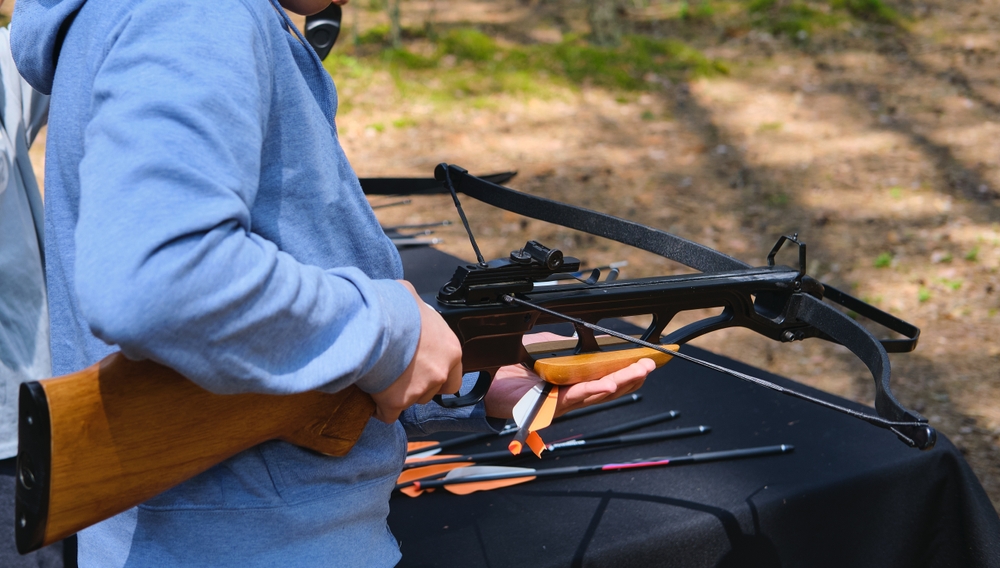
A bolt is the short arrow a crossbow shoots, and it only flies true when its nock sits flat against the string. Loading takes four moves:
- Lift the cocked bow level and point it downrange.
- Hold the bolt near its front end, so your hand stays out of the string’s path.
- Lay it on the rail with the odd-colored vane down in the groove.
- Slide it back under the retention spring until the nock touches the string.
That is all there is to how to load a crossbow, but step four is where beginners slip. A bolt that sits a hair forward leaves the string with nothing solid to push. Field & Stream points out that makers use either moon nocks or flat nocks, so buy the type your manual names.
How to aim a crossbow from a steady rest
To aim a crossbow, seat the stock firmly in your shoulder, rest your cheek on the stock, and place the reticle that matches your distance on the target. Keep both limbs level, and hold the front of the bow on a rest instead of in mid-air.
Shoulder, grip, and cheek weld
Pull the butt into your shoulder pocket and hold the fore-grip from underneath, fingers low. A cheek weld is the contact point between your cheek and the stock that puts your eye behind the scope the same way on every shot. TenPoint’s Crossbow Shooting Basics article describes resting the cheek on top of the stock and sighting with the dominant eye.
Use a rest, not your off-hand
Sources disagree here, so we will take a side. Field & Stream says the offhand form riflemen use is ideal. Bob Robb, writing in American Hunter, says he never releases an arrow without a rest and tells readers not to shoot off-hand at all.
For a beginner, Robb is right. A crossbow carries its weight out front, and a wobbling front end is the fastest way to miss. Shoot from a bench, sticks, a tripod, or a kneeling position, and pad a hard surface with a jacket or your hand, as Robb suggests.
Read the reticle and hold for distance
Most crossbow scopes use stacked dots or lines. American Hunter explains the usual layout: the top mark is zeroed at 20 yards and the marks below it land near 30, 40, and 50. Bowhunter Ed adds a caution that the second line may hit at 28 yards instead of 30, depending on your bolt and bow.
Between marks, expect a curve. Field & Stream’s guide gives a useful rule for a bow sighted dead-on at 20 yards: about 1 to 2 inches high at 15 yards and 2 to 3 inches low at 25.
Squeeze the trigger and follow through
Slide the safety to “fire” only when the reticle is steady on target. TenPoint’s Crossbow Shooting Basics article describes the rest: take a final breath, let out about half, and press the trigger slowly while you keep exhaling. A jerk moves the bow before the bolt leaves.
Then do nothing. Follow-through is the act of holding your aim and head position after the trigger breaks. The Bowhunter Ed course is blunt about why it matters: a bolt takes time to clear the rail, and relaxing too soon makes it strike low. Count two seconds before you look up.
Sight in at 10 yards, then 20
Sighting in is adjusting the scope until the point of aim and the point of impact match at a known distance. TenPoint states that it bore-sights its crossbows at 20 yards at the factory, but a scope still needs checking on your range with your bolts.
The Bowhunter Ed course recommends starting at 10 yards for safety. Shoot a group, adjust until bolts land at the top center of the bullseye, then move back to 20 and fine-tune with three more. Use practice points that match the weight of your hunting heads.
Why did your bolt miss? A symptom-to-fix table
Learning how to shoot a crossbow accurately is mostly learning to read your misses. Each pattern on the target points to one step in the sequence.
| What the target shows | Likely cause | Fix |
|---|---|---|
| Tight group, left or right of center | String latched off center | Check your serving marks and re-cock |
| Bolts hit low | Head lifted or bow dropped early | Hold two seconds after the shot |
| Left-right spread that grows with distance | Limbs tilted (canting) | Level the limbs; add a scope bubble level |
| High at 15 yards, low at 25 | Normal arc from a 20-yard zero | Learn the holds; do not touch the scope |
| One bolt always off | Damaged bolt | Retire it |
| Group opens up over a session | Loose scope or limb bolts | Retighten everything |
| Good on the bench, poor in the field | No rest | Carry sticks or kneel |
Change one thing at a time. If you adjust the scope to cover a cocking error, the error comes back on the next string and the scope is now wrong too.
How to decock a crossbow safely
To decock a crossbow, shoot it. Remove your hunting bolt, load a blunt-tipped bolt kept for the job, and fire into a target, a berm, or soft ground. Field & Stream calls this the only safe way to uncock, and Kalkomey’s Hunter Ed course gives the same instruction.
Some bows add a second option. TenPoint markets models with built-in de-cocking, where a crank lets the string down under control. Use it only if your manual describes it. Never try to ease the string down by hand.
Recurve vs compound: what changes at each step?
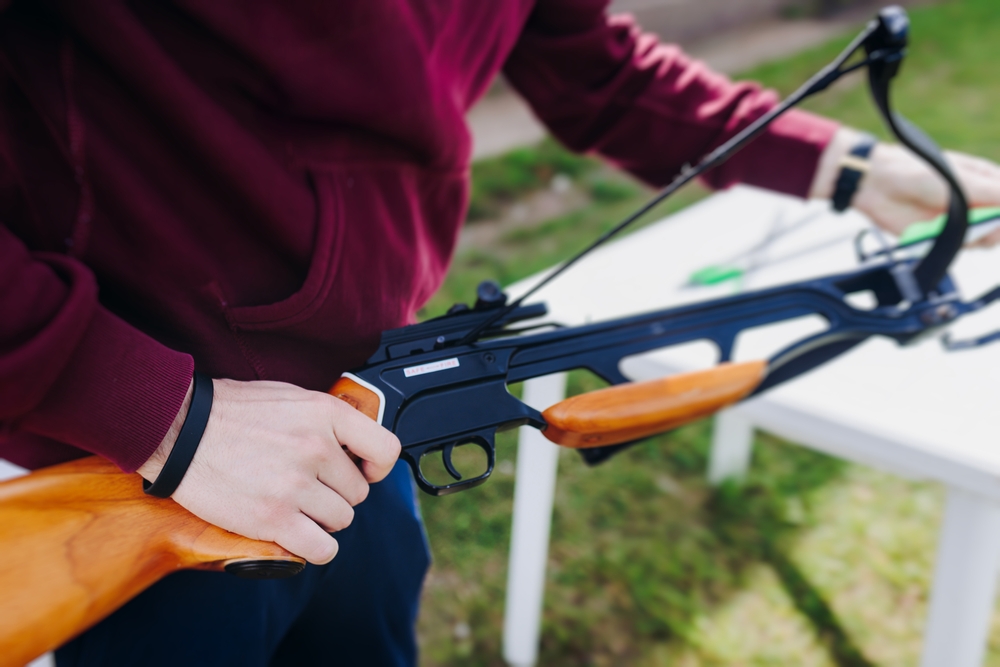
A recurve crossbow uses plain limbs and a single string, while a compound crossbow adds cams and cables to store more energy in a narrower frame. The shot sequence is identical. Three details change.
| Step | Recurve crossbow | Compound crossbow |
|---|---|---|
| Cocking | Harder at the same draw weight; you may have to lean to the side to reach the string | Easier draw for the speed; crank options are common |
| Limb clearance | Check both sides of your rest or blind before the shot | Check it too, even on a narrow bow |
| Upkeep | No cams or cables; a string is simpler to swap | Wax cables as well; cams and axles need lubricant |
The cocking and upkeep rows draw on Field & Stream’s notes on the Excalibur recurve design and on Bowhunter Ed’s cocking steps. If the rest of this page on how to shoot a crossbow reads the same for both designs, that is because it is.
Which crossbow should a beginner start with?
A good crossbow for beginners is one you can cock the same way every time. Draw weight you cannot pull smoothly costs more accuracy than extra speed gives back. A package that includes a scope, bolts, and a cocking aid saves you from matching parts yourself.
BowsHunting.com selects products by research, not hands-on testing. The table lists only details we could confirm from a published source, so open each listing to check the current package contents.
| Crossbow package | Limb design | Confirmed detail |
|---|---|---|
| Barnett Hyper Whitetail bundle | Compound | American Hunter’s first look at the Hyper Whitetail 410 lists up to 410 fps, a 4×32 scope, and a rope cocking sled |
| Killer Instinct Burner bundle | See listing | Sportsman’s Warehouse lists the Burner 415 at 415 fps with an adjustable buttstock |
| Wicked Ridge by TenPoint ready package | See listing | Sold as a ready-to-shoot package from TenPoint’s sister brand |
| Excalibur Suppressor hunt-ready package | Recurve | Listed as a hunt-ready recurve |
| SAS Jaguar recurve package | Recurve | Listed at 175 lb draw and 245 fps with a red dot sight |
| SAS 175 lb recurve package | Recurve | 175 lb draw per the listing title |
| SAS 175 lb recurve package (second listing) | Recurve | 175 lb draw per the listing title |
| 150 lb hunting crossbow with arrows | See listing | 150 lb draw per the listing title |
Slower recurves suit short-range practice and are simpler to maintain. The faster compound bundles suit hunters who want a flatter arc and will use a cocking aid on every shot.
Two more links sit outside that table on purpose. Barnett HyperGhost owners can look at this HyperGhost-compatible Barnett item (BAR20019), after checking the fit against the manual. And this handmade wooden crossbow with rubber-tipped arrows is a toy for kids. Nothing in this guide applies to it, and it is no substitute for a real bow.
Your first practice session: a 10-shot plan
Ten bolts are enough to zero a scope and put how to shoot a crossbow into practice. Set a target with a safe backstop, use a bench or sticks, and check your serving marks after every cock.
- Shots 1 to 3 at 10 yards. Aim at the center. Ignore the scope until all three have landed, then adjust once.
- Shots 4 to 6 at 20 yards. Use the top reticle. Adjust once after the group.
- Shots 7 to 9 at 20 yards. Change nothing. This group is your honest baseline.
- Shot 10. Fire it into the target to leave the bow uncocked.
Finish with two minutes of care. ShootingTime’s crossbow guide advises waxing the string and cables but not the center serving, then spreading two drops of rail lube along the flight rail.
Bob Robb’s term for your limit is Maximum Effective Shooting Range. It is the farthest distance at which you put at least 90 percent of shots in the center, and he advises stretching it in 5-yard steps.
Key takeaways
- The order never changes: inspect, cock, safety, load, shoulder, aim, squeeze, follow through.
- A centered string and a steady rest fix most misses before you touch the scope.
- Zero at 10 yards first, confirm at 20, and learn your holds at 15 and 25.
- Decock by firing a blunt bolt into a safe backstop, and never dry fire.
- The last step in how to shoot a crossbow well is restraint: stay inside 30 yards until nine of ten bolts hit center.
Set a target at 10 yards this week and run the 10-shot plan. For gear roundups and more shooting guides, visit the BowsHunting.com homepage.
Frequently asked questions
These are the questions new shooters ask most, answered in a few lines each.
How far can a crossbow shoot accurately?
Most beginners should treat 20 to 30 yards as their working range. Kalkomey’s Hunter Ed course puts the maximum for most crossbows at 30 to 40 yards, and Field & Stream advises keeping hunting shots to 30 yards and under. TenPoint’s own FAQ advises against hunting shots past 50 yards. Your real limit is the distance where nearly every bolt still lands in the bullseye.
Is it hard to shoot a crossbow?
No. The latch holds the string for you, so the shot itself is simpler than drawing a vertical bow. The hard parts are cocking evenly and staying still through the release. A rope cocker and a solid rest solve both, and the Bowhunter Ed course expects a bolt to land on target at 10 yards from the start.
What happens if you dry fire a crossbow?
With no bolt to carry the energy away, the limbs, string, and cables absorb all of it. That can crack a limb or snap a string. Many current bows include an anti-dry-fire catch, but treat it as a backup. After any dry fire, stop shooting and have an archery shop inspect the bow.
Can you leave a crossbow cocked overnight?
No. Field & Stream’s beginner guide says a crossbow can stay cocked through a day in the field, with the bolt removed whenever you walk or climb, but should be uncocked when the hunt ends. Long periods at full draw stress the limbs and string. Your manual gives the limit for your model.
Do you need a scope to shoot a crossbow?
No, but it helps. American Hunter notes that some crossbows still ship with open sights, and that a scope makes accurate shooting much easier. A multi-reticle scope is the common choice because each mark matches a set distance. Whatever you choose, zero it with the bolts you will actually shoot.
Do you need a license to shoot a crossbow?
It depends on the state and on whether you are hunting. Field & Stream cautions that not every state allows crossbows in archery season and that the rules change often. Check your state wildlife agency’s current regulations for seasons, minimum draw weights, and hunter-education requirements before you take a crossbow afield.