



Affiliate disclosure: Bowshunting earns a commission on qualifying Amazon purchases made through links on this page, at no extra cost to you.
The best rangefinders for bow hunting give you an angle-compensated distance fast, from a few yards out to about 80, in any light. Our top pick is the Leupold RX-1400i TBR/W Gen 2. Below, you’ll be able to match one of 10 models to your stand, your budget, and the shots you actually take.
Quick Picks: The Best Rangefinders for Bow Hunting at a Glance
| Pick | Best for | Max range | Zoom | Angle compensation | Power |
|---|---|---|---|---|---|
| Leupold RX-1400i TBR/W Gen 2 | Best overall | 1,400 yd | 5x | Yes, bow mode + Flightpath | CR2 |
| Vortex Triumph HD 850 | Best value from a major optics brand | 850 yd | 5x | Yes (HCD) | CR2 |
| TIDEWE Hunting Rangefinder | Best for tree stands on a budget | 700 yd | 6x | Yes (angle mode) | Rechargeable |
| AILEMON AL51 | Best budget horizontal-distance readout | 900 yd | 6x | Yes (M1 hunting mode) | See listing |
| PEAKPULSE 1400Yds | Budget pick for deer and bow | 1,400 yd | 6x | Yes | See listing |
| Flagfront N2-HT 1200Yd | Fastest stated reading speed | 1,200 yd | 6x | Yes (angle/slope) | Rechargeable |
| REVASRI Hunting 1000Y | Lowest-cost hunting unit | 1,000 yd | 6.5x | Not confirmed | Rechargeable |
| Acer 800Yd Hunting Range Finder | Bow and golf crossover | 800 yd | 6x | Yes (slope/horizontal) | Rechargeable |
| REDTIGER GolfVue Series 1 | Golfers who also hunt | 1,200 yd | 7x | Slope mode (golf) | Rechargeable |
| REVASRI NK1000 Golf | Backup or shared golf unit | 1,000 yd | 6.5x | Slope mode (golf) | Rechargeable |
How We Chose These 10 Rangefinders
We did not field-test these units, and we won’t pretend otherwise. Bowshunting built this list by checking each model’s published specifications against manufacturer pages and multiple retailer listings, then scoring them on what separates the best rangefinders for bow hunting from generic lasers: angle compensation, minimum range, readout speed, display clarity, and power.
Every spec below appears in at least one manufacturer or retailer source. Where a spec couldn’t be confirmed, we say so rather than guess.
What Makes a Good Bow Hunting Rangefinder?
A bow hunting rangefinder is a handheld laser optic that measures distance to a target and, on the right model, corrects that distance for the angle of the shot. Arrows drop fast, so a 3-yard error matters far more with a bow than with a rifle.
Five features separate a good one from a generic laser:
- Angle compensation. It reports the horizontal distance your arrow actually travels, not the straight line from your eye to the deer.
- Short minimum range. Shots from a tree stand can be under 10 yards. A unit that can’t read close is useless at the moment it matters.
- Fast readout. Deer move. Half a second versus two seconds is the difference between a shot and a missed chance.
- Readable display. Black LCDs disappear against dark timber at dawn. Red displays (Leupold’s TOLED, for example) read better in low light.
- Target priority. Hunting units that range past brush to the farthest target suit the woods; golf units that lock onto the nearest object can read a twig instead of a buck.
Does max range matter for archery?
Barely. A box that says “1,400 yards” describes the maximum distance on a reflective target, not a deer. Most bowhunters shoot inside 60 yards. None of the best rangefinders for bow hunting earn their place on max range. Judge a unit by its minimum range, speed, and angle compensation, and treat max range as a tiebreaker.
Best Rangefinders for Bow Hunting: Reviews
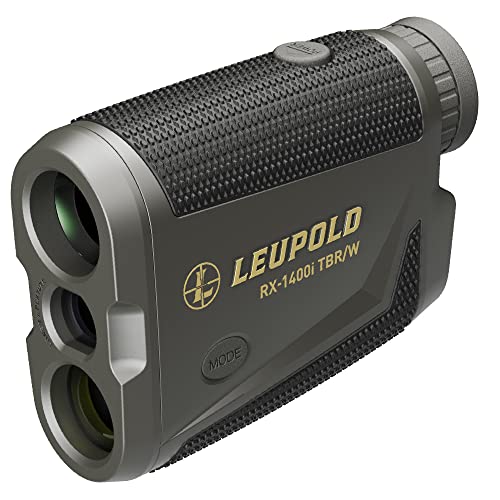
1. Leupold RX-1400i TBR/W Gen 2 Best Overall
Disclaimer: Prices are at time of the review and subject to change.
Key specs: 5x21mm · up to 1,400 yd · bow mode with Flightpath · Line of Sight and Last Target modes · red TOLED display · CR2 battery · 2-year warranty
The RX-1400i Gen 2 is the only model on this list built with a dedicated bow mode, which makes it the strongest all-rounder among the best rangefinders for bow hunting we compared. Its archery mode uses distance and angle to calculate a ballistic-equivalent yardage for uphill and downhill shots, rather than a simple straight-line reading.
Flightpath is the standout feature. It uses your bow’s setup to show the highest point of the arrow’s flight, so you can see whether an overhanging branch is in the way before you release. MeatEater’s under-$500 test called it the steal of the group and noted its 6-yard minimum range.
The Last Target mode matters in the woods. It reports the farthest object in the beam, which helps you range a deer standing behind light brush.
- Pros: true bow mode, obstruction check, red display for dawn and dusk, 6-yard minimum range
- Cons: 5x is less magnification than budget units; CR2 batteries need replacing; most expensive pick here
Best for: anyone who wants one rangefinder for every bowhunting situation.
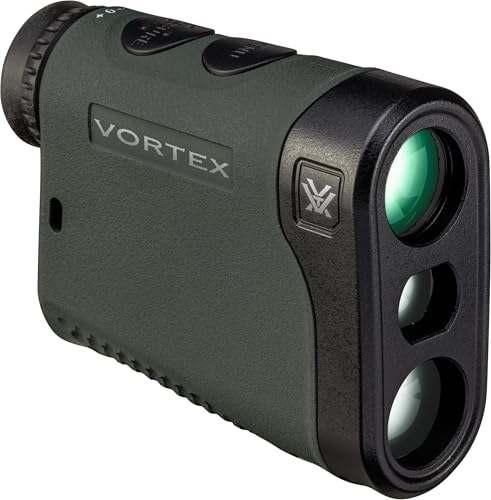
2. Vortex Triumph HD 850 Best Value From a Major Optics Brand
Disclaimer: Prices are at time of the review and subject to change.
Key specs: 5x21mm · up to 850 yd reflective, 500 yd on trees · HCD and LOS modes · angle reading to ±89° · 4.6 oz · CR2 battery · Vortex VIP warranty
The Triumph HD 850 is Vortex’s simplest rangefinder, and simple is what most whitetail hunters need. Its HCD (Horizontal Component Distance) mode gives the angle-compensated distance; LOS mode gives the raw line-of-sight reading.
At 4.6 ounces it weighs less than most budget units on this list. Vortex describes it as built for the distances common to deer hunting, which matches how bowhunters use it.
Among the best rangefinders for bow hunting from a big-name brand, the warranty decides it. Vortex’s VIP coverage is unlimited and lifetime, which no budget brand here can match.
- Pros: proven brand, lifetime warranty, light and compact, true HCD angle compensation
- Cons: no dedicated bow or Flightpath mode; black LCD is harder to read in low light than a red display
Best for: whitetail hunters who want a name-brand rangefinder they never have to think about.
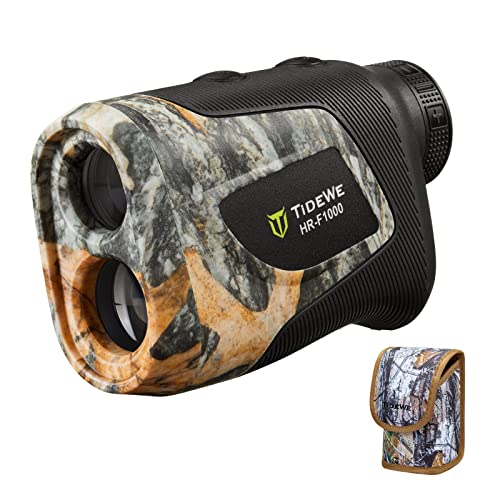
3. TIDEWE Hunting Rangefinder Best for Tree Stands on a Budget
Disclaimer: Prices are at time of the review and subject to change.
Key specs: 6x · 3–700 yd (1,000 yd version available), ±1 yd · distance, angle, speed and scan modes · 7° field of view · built-in 750mAh Li-ion · water-resistant
The TIDEWE’s 3-yard minimum range is the shortest on this list, and that is exactly why it suits tree stands. A deer walking almost under you is still a readable target.
The rechargeable battery removes the classic opening-morning problem of a dead CR2. Charge it before the season and it covers a lot of sits.
It is a straightforward unit with angle mode, scan, and speed. It lacks the polish of Leupold’s display and Vortex’s warranty, but the feature list is strong for the price tier.
- Pros: 3-yard minimum range, rechargeable, water-resistant, four modes
- Cons: black LCD display; budget-brand glass and warranty
Best for: tree-stand hunters who want close-range coverage without paying for a name brand.
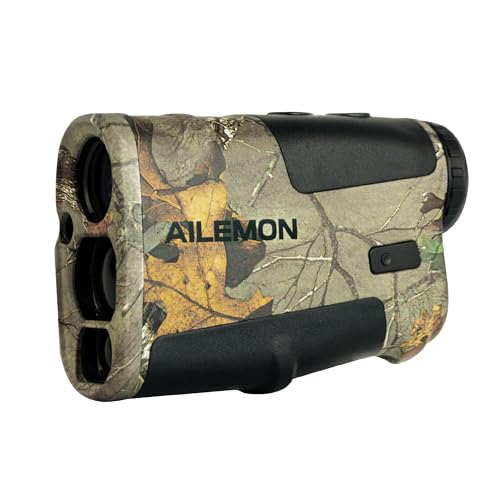
4. AILEMON AL51 Best Budget Horizontal-Distance Readout
Disclaimer: Prices are at time of the review and subject to change.
Key specs: 6x · 5–900 yd, ±1 yd · 0.5-second measurement · M1 hunting mode (line-of-sight, horizontal distance and angle) · M2 height mode · scan · waterproof · camo housing
The AILEMON’s M1 hunting mode shows the line-of-sight distance, horizontal distance, and angle together. Seeing both numbers is useful while you learn how much a tree stand changes your shot.
Measurement takes half a second, and the housing is rated dustproof and waterproof. The camo finish is matte, which helps when you raise it at a deer.
Battery type varies by listing variant, so confirm it on the product page before you buy.
- Pros: shows horizontal and line-of-sight together, quick readout, waterproof
- Cons: check battery type per variant; no bow-specific ballistic mode
Best for: newer bowhunters who want to see exactly how angle changes the yardage.
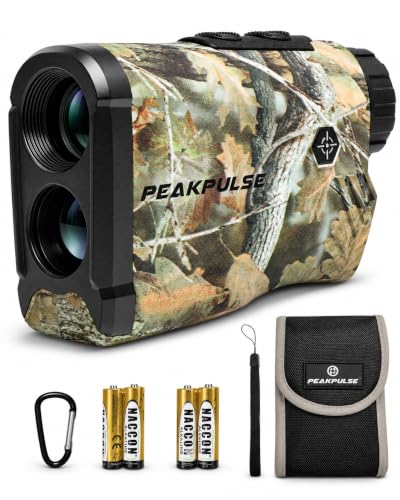
5. PEAKPULSE Hunting Range Finder 1400Yds Budget Pick for Deer and Bow
Disclaimer: Prices are at time of the review and subject to change.
Key specs: 6x · up to 1,400 yd · angle compensation · IP54
PEAKPULSE markets this unit specifically to deer and bow hunters, and it lists angle compensation and an IP54 rating. That covers the essentials of the best rangefinders for bow hunting at a much lower price.
Fewer specs are published for it than for the other models here. We could not confirm its minimum range, battery type, or accuracy figure from a reliable source, so check the listing before buying.
- Pros: angle compensation, IP54, aimed at bowhunters
- Cons: thin published specs; confirm minimum range and battery
Best for: a low-cost backup rangefinder for a second stand or a hunting partner.
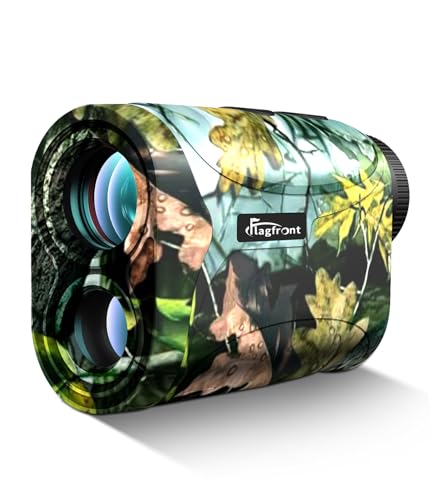
6. Flagfront N2-HT 1200Yd Fastest Stated Reading Speed
Disclaimer: Prices are at time of the review and subject to change.
Key specs: 6x · 5–1,200 yd, ±1 yd · 0.3-second readout · distance, angle, slope and speed modes · rechargeable Li-ion · waterproof · 180 g · 1-year warranty
Flagfront claims a 0.3-second readout, the fastest stated speed on this list. When a deer is about to step behind a tree, that speed has real value.
It combines hunting and golf modes, including slope and speed. Reviewers note a large eyepiece that works well with glasses.
- Pros: fast readings, rechargeable, light, glasses-friendly eyepiece
- Cons: 1-year warranty; golf-crossover design rather than archery-first
Best for: hunters who prize speed and wear glasses.
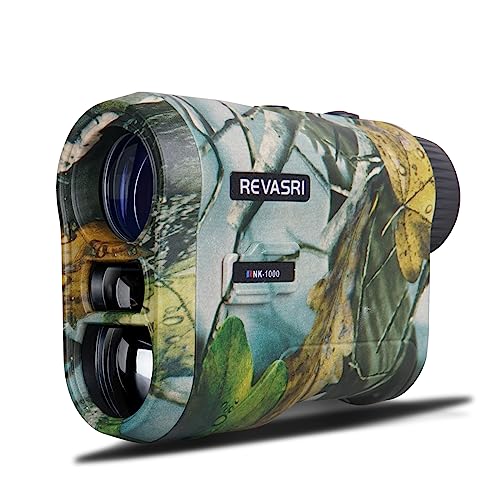
7. REVASRI Hunting Rangefinder 1000Y Lowest-Cost Hunting Unit
Disclaimer: Prices are at time of the review and subject to change.
Key specs: 6.5x · up to 1,000 yd, ±1 yd · Target Acquisition Technology · USB-C rechargeable Li-ion · IP54 · multi-coated lens
This REVASRI is one of the best-selling hunting rangefinders on Amazon. It is often the cheapest real hunting unit you can buy.
The 6.5x magnification is generous and the USB-C charging is convenient. However, we could not confirm angle compensation or a horizontal-distance mode on this exact model from a reliable source. For uphill or downhill archery shots, confirm that feature on the listing before you buy.
- Pros: very low price, rechargeable, IP54, strong magnification
- Cons: angle compensation not confirmed; basic optics
Best for: flat-ground hunters on a tight budget who mainly want a yardage check.
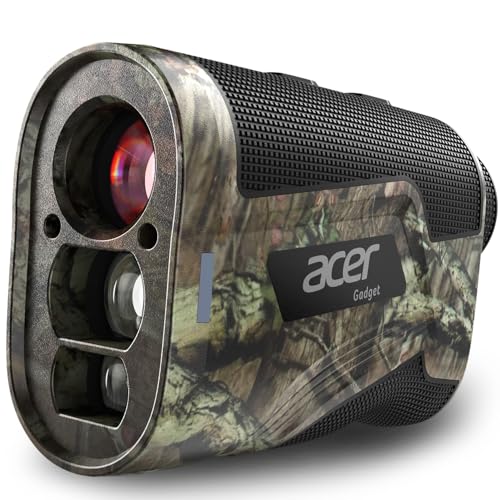
8. Acer 800Yd Hunting Range Finder Best Bow and Golf Crossover
Disclaimer: Prices are at time of the review and subject to change.
Key specs: 6x · up to 800 yd · angle, scan, speed, height, horizontal distance and slope modes · flag-lock vibration · magnetic strip · rechargeable Li-ion
This Acer unit sits halfway between hunting and golf. It offers horizontal-distance and slope modes for archery, plus flag-lock vibration and a magnet for the golf cart.
That makes it a sensible buy for someone who golfs in summer and hunts in fall.
- Pros: wide mode set, rechargeable, works for both sports
- Cons: golf features add buttons and menus you won’t use in a stand
Best for: a household that wants one rangefinder for the course and the woods.
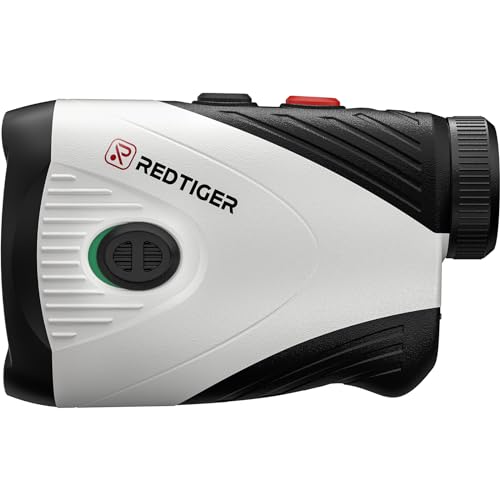
9. REDTIGER GolfVue Series 1 For Golfers Who Also Hunt
Disclaimer: Prices are at time of the review and subject to change.
Key specs: 7x · 5–1,200 yd, ±0.5 yd · slope on/off switch · flag-pole lock with vibration · magnetic mount · USB-C 750mAh · IP54 · 2-year assurance
The REDTIGER is a golf rangefinder first. Its 7x zoom and ±0.5-yard accuracy are the best published figures in this group, and its slope mode works as angle compensation.
The catch is target priority. Golf units are designed to lock onto the nearest object so they pick the flag instead of the trees behind it. In the woods, that can mean ranging a branch in front of a deer.
- Pros: 7x zoom, ±0.5-yard accuracy, rechargeable, IP54
- Cons: nearest-target behaviour suits golf, not brushy hunting
Best for: golfers who hunt open fields and food plots with clear shooting lanes.
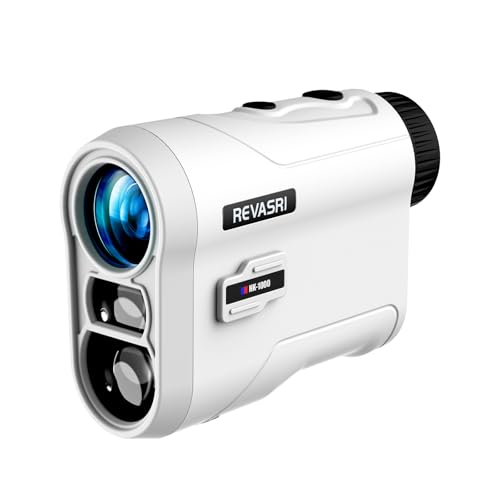
10. REVASRI NK1000 Golf Rangefinder Backup or Shared Golf Unit
Disclaimer: Prices are at time of the review and subject to change.
Key specs: 6.5x · up to 1,000 yd, ±1 yd · 0.5-second measurement · external slope switch · pin-lock vibration · built-in Li-ion with USB-C
The NK1000 is a budget golf rangefinder with slope compensation and a tournament-legal slope switch. It will give you angle-adjusted yardage on open shots.
Like the REDTIGER, it is built to find the closest target, so it is a weaker fit for wooded stands.
- Pros: very low price, slope mode, rechargeable
- Cons: golf-first design; nearest-target priority in brush
Best for: a spare unit, or a golfer trying bowhunting for the first time.
Rangefinder With Angle Compensation Why It Changes Your Shot
A rangefinder with angle compensation calculates the horizontal distance to your target, which is the distance gravity acts on your arrow. A plain laser reports the line-of-sight distance, which is always longer on an uphill or downhill shot. It’s the single feature every one of the best rangefinders for bow hunting shares.
Rangefinder for tree stand hunting: a worked example
Say you sit in a stand 20 feet up, roughly 6.7 yards high.
| Deer’s horizontal distance | Line-of-sight reading | Error without angle compensation |
|---|---|---|
| 15 yd | 16.4 yd | About 1.4 yd high |
| 5 yd | 8.3 yd | About 3.3 yd high |
At 15 yards the error is small. Right under the stand it becomes 3 yards, and that is how an arrow sails over a deer’s back. Angle compensation removes the guesswork.
On steep western terrain the gap grows with distance. A 40-yard downhill reading at a 35° angle works out to roughly 33 yards horizontal. Ballistic modes like Leupold’s TBR go a step further and adjust for the arrow’s actual flight, not just the geometry.
Golf Rangefinder for Bow Hunting: Will It Work?
Yes, with limits. Most golf rangefinders have a slope mode, which is a form of angle compensation, so the number they give you on a clear shot is usable.
The problem is target priority. Golf units lock onto the closest object so they pick the flag over the trees behind it. A hunter wants the opposite: to range through a screen of twigs to the animal. In open fields a golf unit is fine; in thick woods, a hunting unit with distant- or last-target priority is the better tool. That’s why the golf models sit at the bottom of our list.
How to Choose the Right Model for Your Hunt
The best rangefinders for bow hunting are the ones that match how you hunt, not the biggest number on the box.
- Tree stand, whitetail: prioritize minimum range and angle compensation. The TIDEWE (3-yard minimum) or the Leupold (6-yard minimum, bow mode).
- Ground blind or still-hunting: prioritize speed and a quiet, simple button layout. The Vortex Triumph HD 850 or the Flagfront.
- Western spot-and-stalk: prioritize a true ballistic bow mode and a readable display at long archery ranges. The Leupold RX-1400i.
- Tight budget: the best budget rangefinder for bow hunting is one that still has angle compensation. The AILEMON AL51 or the TIDEWE, rather than a golf unit.
- One unit for golf and hunting: the Acer 800Yd or the REDTIGER, accepting the nearest-target trade-off.
Rechargeable or CR2 battery?
Rechargeable units save you buying batteries and are convenient to top up. CR2-powered units like the Leupold and Vortex let you swap in a fresh battery in the field, which some hunters prefer on long, cold trips. Either way, carry a backup: a spare CR2 or a small power bank.
What about rangefinder bow mode?
A rangefinder bow mode is a preset tuned for archery distances, usually with angle compensation built in. On premium units like the Leupold, it may also use ballistic data for your arrow speed. On budget units, “bow mode” often just means horizontal distance. Read the listing to see which you are getting.
Key Takeaways
- Angle compensation is non-negotiable for tree stands and hilly ground. All of the best rangefinders for bow hunting on this list offer it, except where we flag it as unconfirmed.
- Minimum range beats maximum range. The TIDEWE reads from 3 yards, and the Leupold from 6.
- The Leupold RX-1400i TBR/W Gen 2 is the best all-round pick, thanks to bow mode, Flightpath, and a red display.
- The Vortex Triumph HD 850 is the safest value buy, backed by a lifetime warranty.
- Golf rangefinders work in open country but lock onto the nearest object in brush.
Ready to stop guessing yardage? Pick the model that matches your stand and your budget, and check today’s price on the Leupold RX-1400i TBR/W Gen 2.
Frequently Asked Questions
Do you need a rangefinder for bow hunting?
You don’t strictly need one, but it makes clean, ethical shots far more likely. Many experienced hunters still range landmarks around their stand before the deer arrive, so they know the yardage to each tree and trail. A rangefinder does that job in seconds and confirms the distance when an animal appears somewhere unexpected.
What is angle compensation on a rangefinder?
Angle compensation reports the horizontal distance to your target instead of the straight-line distance. On uphill or downhill shots, the horizontal distance is shorter, and it’s the number to aim by.
Can I use a golf rangefinder for bow hunting?
Yes, if it has a slope mode and you hunt open ground. Golf units lock onto the nearest object, so in thick brush they may range a branch instead of the deer.
How far does an archery rangefinder need to range?
Far less than the box suggests. Most bowhunting shots fall inside 60 yards, so minimum range, speed, and angle compensation matter more than a 1,000-yard maximum.
What magnification is best for bowhunting?
Most bowhunting units use 5x to 7x. Lower magnification gives a wider field of view and a steadier picture, which helps on close, fast shots. Outdoor Life’s FullDraw 5 review made the same point, preferring less magnification for an archery-specific unit.
Is a bow mode the same as angle compensation?
Not always. On premium units, bow mode can combine angle compensation with your arrow’s ballistics. On many budget units, it simply means the horizontal-distance readout.
